
Tree Cabling and Bracing Columbus OH — Save Valuable Trees Before They Fail
Not every structurally compromised tree needs to come down. Some trees — mature oaks that have stood for a century, a beloved shade tree over your backyard, a specimen tree that defines your property’s character — are worth saving when the right intervention is available. Tree cabling and bracing provides that intervention. It reinforces weakened trees against the forces that would otherwise cause them to fail, extending their safe life significantly when the structural problem is identified early enough.
BuckeyeTree Pro provides professional tree cabling and bracing across Columbus and Franklin County. Our ISA certified arborists assess each tree individually, determine whether cabling or bracing is an appropriate solution, and install support systems that protect both the tree and your property for years to come.
📞 Call (614) 259-1714 — Call for an On-Site Assessment
What Is Tree Cabling and Bracing
Cabling and bracing are two distinct but often complementary structural support systems installed in trees with identified weaknesses.
Tree Cabling
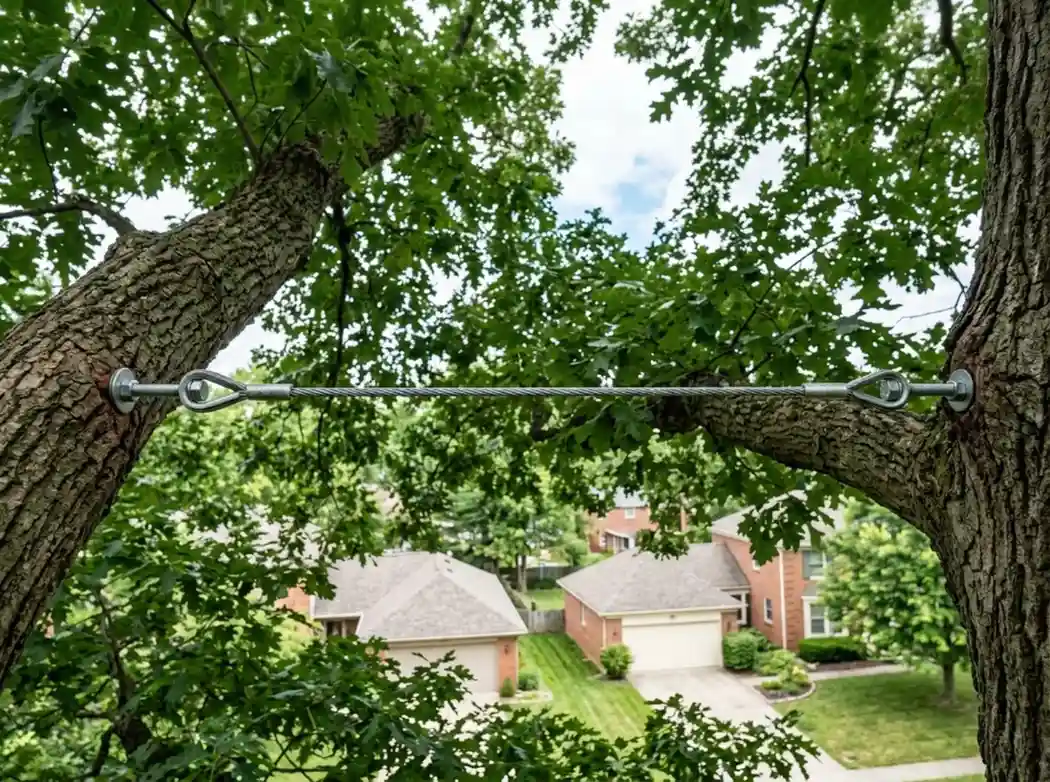
Cabling installs high-strength steel or synthetic cables between major branches or stems to limit their independent movement during wind and storm events. Cables are installed in the upper canopy and work by distributing the load between multiple stems — preventing the movement that leads to splitting at weak attachment points. Cabling is most commonly used for trees with co-dominant stems, included bark, or wide-angle branch attachments that are at risk of splitting under load.
Tree Bracing
Bracing installs threaded steel rods through weakened crotches, split sections, or cracked stems to provide rigid support and prevent further separation. Where cabling limits movement, bracing physically holds split or cracking sections together. Bracing is used when a structural failure has already begun — a split that has not yet fully separated, a crack in the main stem — and the goal is to stabilize the existing damage.
When Cabling and Bracing Are Used Together
Many Columbus trees benefit from both systems working together. A tree with a co-dominant stem and included bark may receive cabling in the upper canopy to limit movement during storms, combined with a brace rod through the included bark crotch to prevent the existing weakness from progressing. Our arborist determines the right combination based on each tree’s specific structural situation.
Not sure if your tree can be saved? We will give you an honest assessment.
📞 Call (614) 259-1714Signs Your Tree May Need Cabling or Bracing in Columbus OH
Co-Dominant Stems
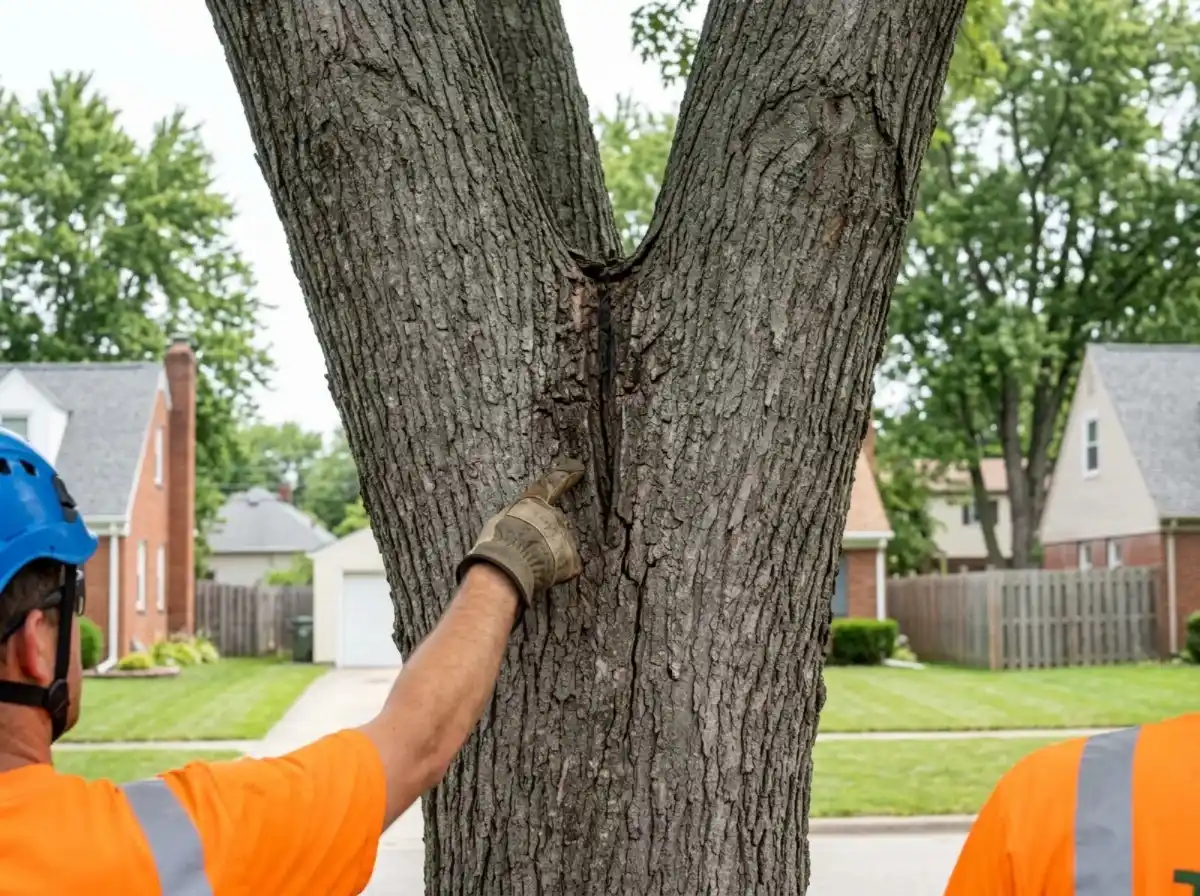
A tree with two or more main stems growing from a single point — co-dominant stems — is one of the most common cabling candidates in Columbus. When co-dominant stems develop included bark at their union, the attachment is structurally weak and at significant risk of splitting under load. This is extremely common in silver maples, which were planted extensively throughout Franklin County and frequently develop co-dominant structure.
Included Bark at Branch Unions
Included bark forms when two stems or branches grow so closely together that bark is trapped between them rather than forming a proper union. Included bark unions are weak — they do not bond the way a proper union does and are prone to splitting, especially under ice load and high winds common to Columbus winters.
Previous Storm Damage with Partial Splitting
A branch or stem that has partially split but not yet fully separated may be a candidate for bracing — if the split is recent, the wood is sound, and the structural situation is salvageable. Our arborist assesses whether the damage can be stabilized or whether removal is the safer answer.
Large Overextended Limbs
Limbs that have grown exceptionally long relative to their base diameter create significant leverage during wind events — far more than the attachment point was designed to bear. Cabling these limbs back to the main stem or other major branches reduces the leverage and the risk of failure.
High-Value Trees Worth Preserving
A 100-year-old oak in your Bexley backyard, a mature beech in German Village, a specimen tree that defines your property’s character — some trees have value that justifies the investment in structural support when the alternative is removal. Our arborists assess each situation honestly and tell you when cabling is a sound investment and when it is not.
Our Tree Cabling and Bracing Process in Columbus OH
Cabling and bracing installation requires climbing into the canopy, working at height, and making precise decisions about hardware placement, cable tension, and anchor points. This is specialized work — not every tree company has the training or equipment to do it correctly.
Columbus’s most common cabling candidates are silver maples with co-dominant stems — a structural issue we encounter regularly in Clintonville, Worthington, and Grandview Heights, where these trees were planted widely in the mid-20th century and are now mature with established structural weaknesses. We also handle frequent cabling requests for large oaks in Upper Arlington and Bexley, where property owners want to preserve century-old trees that have developed storm damage or structural concerns.
Structural Assessment
Our ISA certified arborist performs a detailed structural assessment — evaluating the tree’s overall health, identifying specific weaknesses, assessing the risk of failure without intervention, and determining whether cabling, bracing, or a combination is appropriate. Not every tree is a candidate — we tell you honestly when cabling is the right answer and when it is not.
Hardware Selection and Installation Planning
We select the appropriate cable system — high-strength steel for permanent installations, synthetic flexible cable for situations requiring more natural movement — and plan anchor point locations based on the tree’s structure and the forces we need to counteract.
Cable and Brace Installation
Our arborists install cables at the appropriate height in the canopy — typically two-thirds of the distance from the weak union to the branch tips — and tension them correctly. Brace rods are installed through weakened crotches at the appropriate angle and depth for maximum support.
Follow-Up Inspection Schedule
Cabling and bracing systems require periodic inspection — typically every one to two years — to assess cable condition, tension, and whether the tree’s growth has affected the installation. We set up a recommended inspection schedule at the time of installation.
Real Project — Silver Maple Cabling in Worthington OH
A homeowner in Worthington had a large silver maple with two co-dominant stems, each approximately 18 inches in diameter, meeting at a tight crotch with visible included bark. The tree was positioned between the home and the detached garage — a fall in either direction would cause significant structural damage. The homeowner wanted to preserve the tree if possible.
Our arborist assessed the tree and determined it was a strong cabling candidate — both stems were healthy, the included bark crotch had not yet begun to crack, and the tree’s overall root system was sound. We installed a high-strength steel cable system between the two stems at the appropriate height and angle, combined with a single brace rod through the crotch to prevent the included bark union from progressing.
The tree was preserved. The homeowner avoided the cost and loss of removing a mature shade tree that defined their backyard. At the one-year follow-up inspection, both the cable and brace remained in correct condition and the crotch showed no further progression. A sound investment in a tree worth keeping.
Why Choose BuckeyeTree Pro for Tree Cabling and Bracing in Columbus
📞 Call (614) 259-1714 for tree cabling and bracing across Columbus OH
Areas We Serve for Tree Cabling and Bracing in Columbus OH
BuckeyeTree Pro provides tree cabling and bracing throughout Columbus and Franklin County including Dublin, Westerville, Gahanna, Hilliard, Grove City, Upper Arlington, Worthington, Reynoldsburg, Pickerington, New Albany, Bexley, Powell, Canal Winchester, and Grandview Heights.
Frequently Asked Questions — Tree Cabling and Bracing Columbus OH
The most common indicators are co-dominant stems with included bark, large overextended limbs, previous partial splitting, or a tree that has survived storms but shows structural stress. Our arborist assesses each tree individually — call (614) 259-1714 and we will evaluate your specific situation.
High-strength steel cable systems are designed for long-term use but require inspection every one to two years to assess condition and tension. Tree growth can affect cable placement over time. We schedule a recommended inspection timeline at installation and assess the system at each visit.
Cabling and bracing manage structural risk — they do not eliminate the underlying weakness. A properly installed and maintained system can extend a tree’s safe life significantly, but it requires ongoing monitoring. Our arborists are honest about long-term prognosis at the time of assessment.
No. Cabling and bracing are appropriate for trees with specific types of structural weakness where the overall tree is otherwise healthy. Trees with advanced decay, root failure, serious disease, or extensive structural damage are typically not good cabling candidates. We assess each tree honestly and recommend removal when it is the safer answer.
Modern synthetic cable systems are less visible than traditional steel and are designed to be as unobtrusive as possible. Steel systems are more visible but are still installed high in the canopy where they are not prominent from ground level. Our arborist explains what the installation will look like before work begins.
Cabling installs support between branches or stems within the tree’s canopy. Propping uses external supports — posts or poles — placed under overextended limbs from below. Propping is occasionally appropriate for specific situations but is generally considered a less elegant and less effective long-term solution than properly installed cabling.
📞 Ready to schedule? Call BuckeyeTree Pro at (614) 259-1714
Save the Trees Worth Saving — Call BuckeyeTree Pro Today
Some trees are irreplaceable. When the right structural intervention can extend their safe life, BuckeyeTree Pro provides it — honestly assessed, professionally installed, and properly maintained.
Also see our related services: Tree Risk Assessment Columbus OH | Tree Pruning Columbus OH | Tree Removal Columbus OH
📞 BuckeyeTree Pro — Tree Cabling and Bracing Columbus OH — Call (614) 259-1714
Ready to Save the Trees Worth Saving?
BuckeyeTree Pro — 4466 Morse Rd, Columbus, OH 43230
📞 Call (614) 259-1714 Now