Ohio’s Duty to Inspect: When a Dead Tree Becomes Your Legal Problem
A dead tree stands in your back yard for three years. In a February windstorm it drops a limb through your neighbor’s roof. Are you liable?
In Ohio the answer turns on one question most homeowners have never heard of: did you have a duty to inspect that tree in the first place? And the answer depends on whether the law considers your property urban or rural — a distinction the Ohio Supreme Court drew four decades ago and courts still apply today.
The case that set the rule: Heckert v. Patrick
The controlling authority is Heckert v. Patrick, 15 Ohio St.3d 402, 473 N.E.2d 1204 (1984). The Ohio Supreme Court, adopting the framework of the Restatement (Second) of Torts § 363(2), held that an urban property owner has a duty of reasonable care relative to a tree that overhangs a public street — including inspection to make sure that it is safe.
Read that again, because the operative word is inspection. This is not a rule about what you knew. It is a rule about what you were obliged to find out.
The rural rule is the opposite. A rural landowner has no affirmative duty to inspect trees on the property. Liability attaches only where the owner had actual or constructive notice of a patent defect — meaning the danger was obvious, or something put the owner on notice of it.
Ohio appellate courts have continued to apply this split. In Rababy v. Metter, 2015-Ohio-1449, the court walked through the same urban/rural analysis in deciding a falling-tree claim.
Why this matters so much in Franklin County
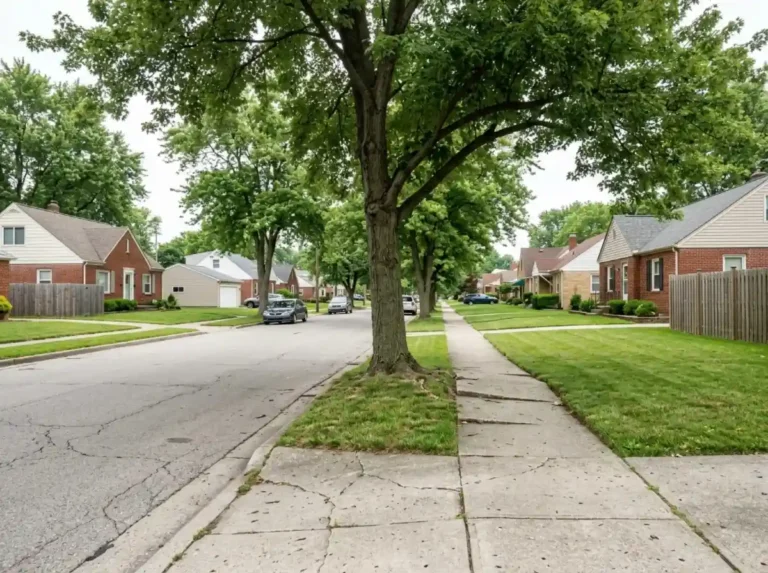
Columbus and its suburbs are, for this purpose, about as urban as Ohio gets. If you own a home in Upper Arlington, Bexley, Whitehall, Clintonville, or Grandview — and you have a tree whose canopy reaches over the street or the sidewalk — you are squarely inside the urban rule.
That means “I didn’t know it was dead” is a weaker defense here than most homeowners assume. The urban standard asks whether a reasonable owner, exercising reasonable care, would have discovered the defect. A tree that has been leafless through two full summers is not a hidden defect.
What courts treat as “on notice”
Even under the rural standard — and certainly under the urban one — the following tend to be treated as visible warnings a reasonable owner should have acted on:
- No leaf-out on all or part of the canopy during the growing season
- Large sections of bark sloughing off the trunk, exposing bare wood
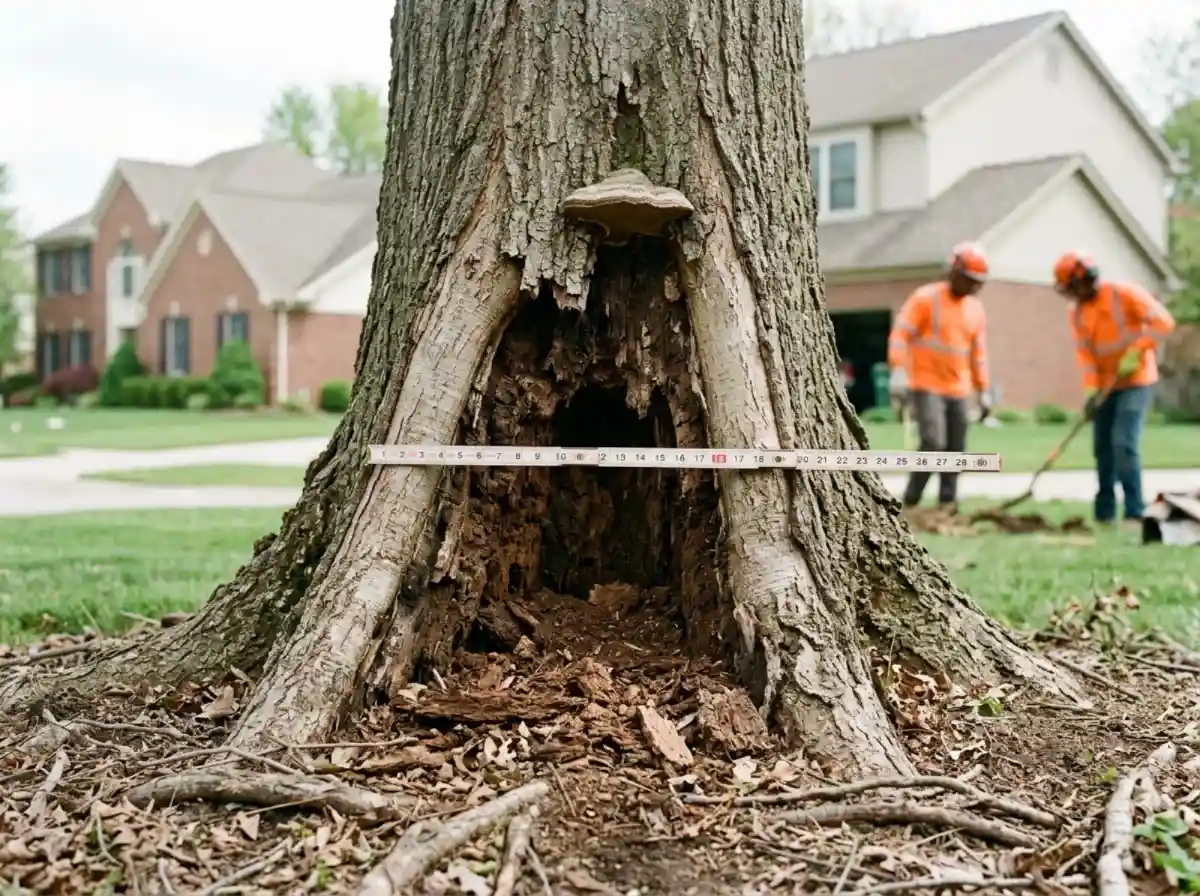
- Mushrooms or conks growing on the trunk, root flare, or at the base — a classic sign of internal decay
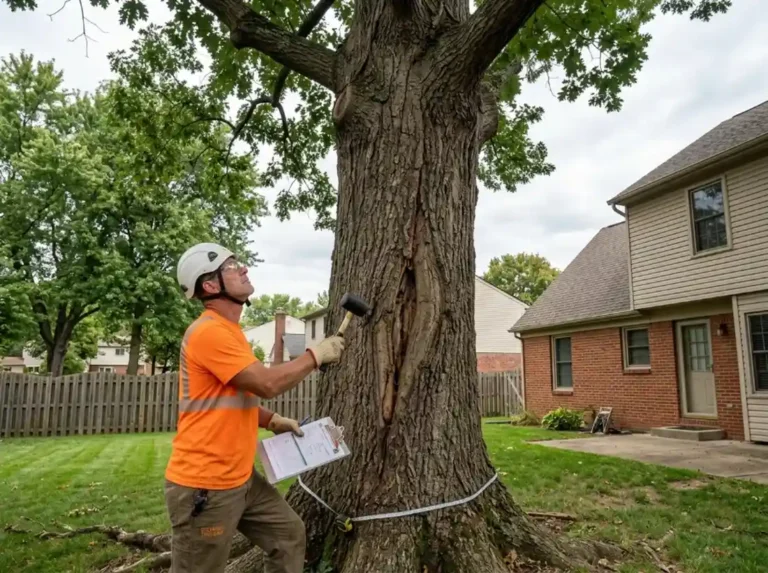
- A hollow or cavity in the trunk, or soft wood you can push a screwdriver into
- A visible lean that has changed, especially with cracked or heaved soil on the opposite side
- Dead limbs hanging in the canopy after a storm and left there
- A written or verbal complaint from a neighbor, the city, or a utility
That last one is the quietest liability trap. Once a neighbor has told you the tree worries them, the “I had no notice” argument is largely gone — in writing or not.
The neighbor’s branch: a separate rule
Two situations get confused constantly, so keep them apart:
- A healthy tree whose branches overhang your yard. Ohio follows the general rule that you may trim back what crosses the property line, at your own cost, up to the boundary — without crossing onto the neighbor’s land and without killing the tree.
- A dead or defective tree that falls and causes damage. This is negligence, and it is governed by the duty analysis above — not by where the branches happened to hang.
A falling healthy tree in a genuine storm is usually treated as an act of God with no liability. A falling dead tree in the same storm is a very different conversation, because the storm did not make the tree dead.
What this means practically
If the tree is yours
Walk your property once a year, ideally in June or July when everything that is alive has leafed out. A tree that is bare in mid-summer is telling you something a February inspection cannot.
If you find something questionable, get a written assessment rather than a guess. A dated, documented tree risk assessment does two things: it tells you whether the tree actually needs to come down, and it creates a record that you exercised reasonable care — which is the exact thing the urban standard measures.
If the tree is your neighbor’s
Put your concern in writing — a text or an email is enough — and keep a copy with a date. Take photographs of the defect from your side of the line. You are not being difficult; you are establishing notice. If the tree later comes down on your property, the difference between “they knew” and “they say they didn’t” is often that one message.
If it has already fallen
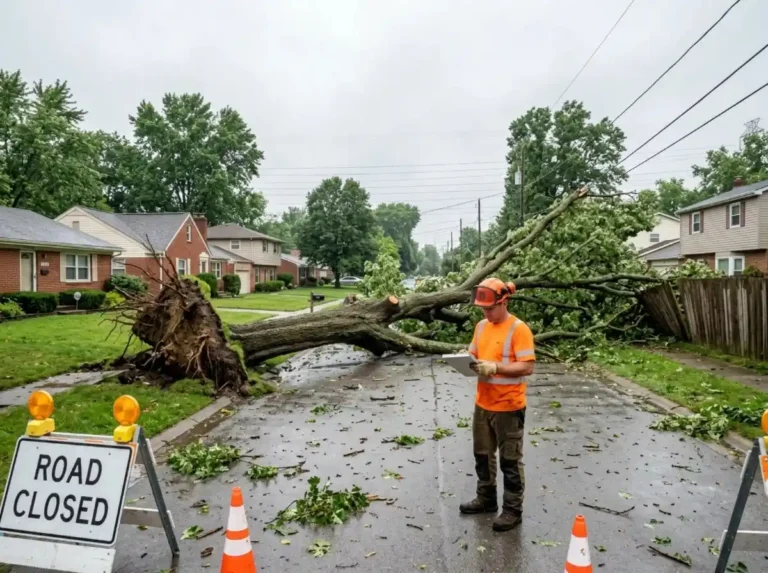
Photograph the stump and the break point before anything is cut or moved. Rot, hollowing, and old decay are visible at the failure surface and they disappear the moment cleanup starts. That photograph is frequently the entire case.
Then deal with safety first. If a tree is down on a structure, a vehicle, or across a driveway, our emergency tree service in Columbus operates around the clock, and we document the failure surface as part of the work.
Removal is usually cheaper than the argument
A standing dead tree in a Columbus back yard is a known, documented, entirely foreseeable hazard. Once it fails, the cost is not the removal — it is the roof, the car, the fence, the deductible, and the months of correspondence.
If you already know a tree on your property is dead or declining, removing it before the next windstorm is the cheapest outcome available to you. If only part of the canopy is dead, deadwooding may be enough — an assessment will tell you which.
Not sure which one you are looking at? Call (614) 259-1714 and we will take a look at it.
This article explains publicly reported Ohio case law for general information. It is not legal advice, and we are not attorneys. Outcomes turn on the specific facts of each case. If you are facing an actual claim, consult a licensed Ohio attorney.