Columbus Rewrote Its Entire Tree Code. Here Is What It Now Says.
Columbus quietly replaced its entire tree ordinance a couple of years ago, and almost nobody outside the industry noticed. Chapter 912 of the city code — the chapter that decides what you may and may not do to a tree here — had been in place since 1991. On 14 December 2023, City Council passed ordinance 2800-2023: “To amend City Code Chapter 912, Trees and Shrubs, by repealing and replacing the chapter in its entirety.”
Not amended. Repealed and replaced. Then in May 2024 the city published a 76-page Tree Technical Manual that fills in the numbers the code leaves out. Between those two documents there are now specific, enforceable rules that catch out homeowners, landscapers and general contractors on a weekly basis. Here is what they actually say.
The list of things that need a permit is longer than you would guess
Most people assume a permit is for cutting a tree down. In Columbus, for a public tree, the permit covers nearly everything you could do to it. Section 912.05(A):
“No person shall plant, set out, or engage in the maintenance of any tree or shrub by removal, stump grinding, application of herbicide or other chemicals, fertilizing, bracing, cabling, pruning, surgery work, cutting above or below the ground, or cutting of roots in a public street, park, or public space without first obtaining a permit issued by the department.”
Columbus City Code §912.05(A)
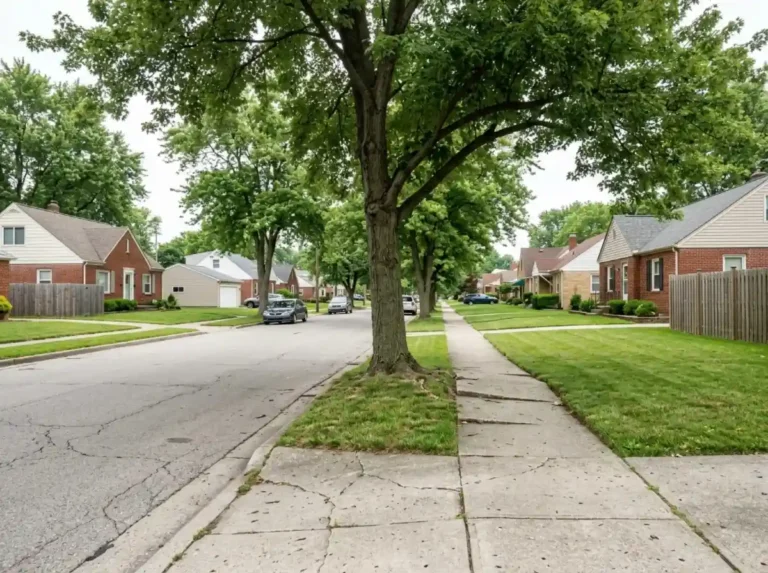
Read that list again. Fertilizing needs a permit. Cabling needs a permit. Stump grinding needs a permit. Spraying weedkiller near the roots needs a permit. And “public street” includes the tree lawn — that strip between the sidewalk and the curb that runs along the front of your property but is not, legally, your property.
If a tree sits right on the boundary, the Tree Technical Manual settles it by trunk position: the tree belongs to the city if the majority of the trunk is on city land (§1.4). Not the majority of the canopy, not where the roots run. The trunk.
The permit is free, but you cannot be the one to ask for it
This is the part that surprises people most. There is no fee to apply for a Forestry permit. The city is not trying to make money here. But you personally cannot file it. Section 912.05(C)(2) requires that all work on a public tree “shall be approved for execution by certified arborists or by people working under the supervision of a certified arborist,” and the Tree Technical Manual spells out the practical consequence at §3.3d: a property owner wanting work on a public tree must “hire a Certified Arborist, who will in turn apply for the Forestry Permit.”
So the sequence is: hire the arborist first, permit second, work third. Routine maintenance needs at least 14 days’ notice. Emergency work is handled differently — for genuine emergencies the permit can follow, but the manual gives you 10 business days to file it after the fact, not indefinitely.
The uncomfortable version of this: if a crew tells you they will “just take care of” a tree lawn tree without paperwork, they are either not certified or not intending to file. Either way the exposure lands on the property owner as much as on them.
What the city thinks a street tree is worth: $260 an inch
When a public tree is removed with permission, the loss has to be made good. The Tree Technical Manual sets replacement at inch for inch — the caliper inches of the replacement trees have to add up to the trunk inches removed (§5.2), and replacements must be at least two inches caliper when planted. Where replanting on site is not possible, you pay into the Tree Fund instead, and §5.3 puts a number on it: “A fee of $260 per removed inch shall be assessed.”
Do the arithmetic on an ordinary mature street maple:
| Trunk diameter | Tree Fund payment at $260/inch |
|---|---|
| 12 inches | $3,120 |
| 20 inches | $5,200 |
| 30 inches | $7,800 |
And the department reserves the right to appraise a particular tree higher than the standard rate where its condition, species or character justifies it (§5.3). There is also a separate inspection fee schedule for mitigation replanting, starting at $700 for the first 1–19 trees.
That figure is worth carrying around in your head, because it is the number sitting behind the sentence “we damaged a city tree by accident.”
“Damage” now includes pruning too hard
The rewritten chapter defines damage much more broadly than snapping a limb. Under §912.01(D) it covers “removal, root cutting, root removal, girdling, soil compaction, soil contamination, topping, pruning more than 20% of the tree’s canopy, bark removal, poisoning and/or actions contributing to the decline or death of a tree.”

Three things in there catch people who thought they were being careful:
- Pruning more than 20% of the canopy is damage by definition — not a judgement call about whether the tree survived it.
- Soil compaction is damage. Parking a skid steer or a stack of pavers over the root zone counts, even though nothing was cut.
- Topping is damage. The manual separately prohibits heading and stub cuts outright, on the grounds that they “result in exposed areas of the tree that can’t heal.”
There is also a rule most homeowners have never heard: climbing spikes may not be used on a tree that is being pruned (§8.1g). If you watch a crew spike their way up a tree they are only trimming, you are watching a code violation and a wound every few feet up the trunk. That standard is one of the reasons how a tree is pruned matters more here than in cities with looser rules, and why crown reduction done properly looks nothing like topping.
As for the penalty, §912.99 is short: a violation of the chapter is a misdemeanor of the third degree, and — the part that does the real work — “Any such violation shall constitute a separate offense on each day the violation exists.” An unabated problem does not sit still; it accrues.
Your driveway job is a tree job whether you meant it to be
Section 912.05(B) requires a permit before you “excavate any ditch, tunnel or trench, or lay any drive” within ten feet of a public tree, or within its tree protection zone — whichever is larger. And the protection zone is generous. The manual sizes the critical root zone at a radius of 1.5 feet for every inch of trunk diameter:
| Trunk diameter | Critical root zone radius |
|---|---|
| 4 inches | 6 feet |
| 8 inches | 12 feet |
| 20 inches | 30 feet |
| 40 inches | 60 feet |
A 20-inch street tree throws a 30-foot protected radius. In most Columbus neighbourhoods that reaches the sidewalk, the apron, the water line and a good part of the front yard. Replacing a driveway, running a new sewer lateral, putting in a fence — all of it can land inside the zone. Where fencing is required during construction it has to stay up for the whole phase: heavy-duty snow fence at least 40 inches high, steel posts every 8 to 10 feet.
Eight feet over the sidewalk, fourteen and a half over the street
Clearance pruning is the most common reason a homeowner looks at a tree lawn tree and thinks something needs to come off. The manual sets the targets at §6.1b: typical clearance is 8 feet over sidewalks and 14.5 feet over vehicular trafficked areas. Street signs want 10 feet of separation from the trunk.

But there is a ceiling on how you get there — no more than 25% of the canopy may be pruned to achieve clearance, and on a mature tree the crown may be raised to no more than one third of the tree’s height. A tree that has been left alone for fifteen years often cannot be brought to clearance legally in one visit. It takes two or three cycles. Any company promising to fix it in an afternoon is telling you something about how they work.
On your own land it is still your call — with two exceptions
None of the above applies to the maple in your back garden. Section 912.02 scopes the chapter to “all trees owned or under the control of the city except as otherwise specifically provided.” No city permit is required to remove a tree on private property in Columbus. That is a real difference from a lot of cities our size, and it is worth knowing before someone tells you otherwise.
Two things still reach onto private land:
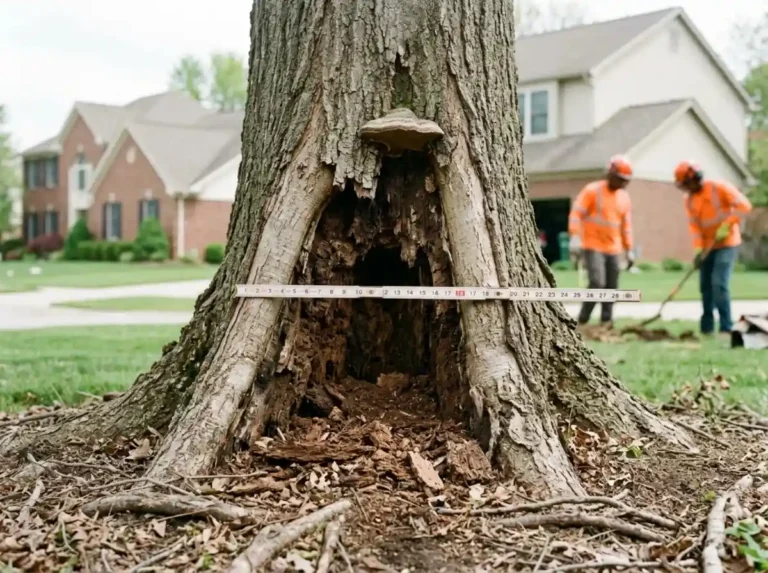
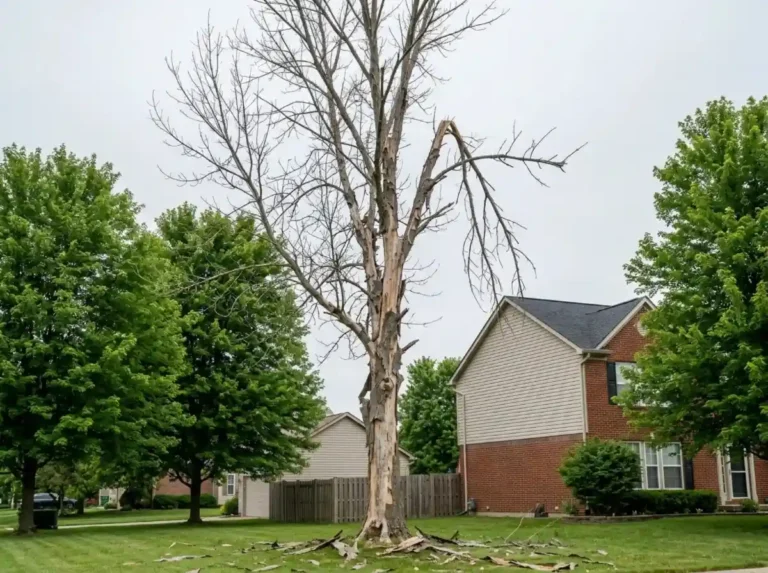
- Private nuisance trees. Section 912.08 makes it “unlawful for any property owner to permit to stand on the owner’s property any tree, shrub, or plant material that has been deemed a public nuisance without promptly abating the nuisance.” A tree is a nuisance under that section when it is sufficiently damaged, diseased or disfigured, or poses a risk to the public or to other plants on public property. So a dead tree leaning over the sidewalk is not purely your business. If you are not sure which category yours is in, that is exactly what a documented risk assessment is for.
- Your neighbour’s tree. Ohio law is unforgiving here. Revised Code 901.51: “No person, without privilege to do so, shall recklessly cut down, destroy, girdle, or otherwise injure a vine, bush, shrub, sapling, tree, or crop standing or growing on the land of another or upon public land.” Whoever violates it “is liable in treble damages for the injury caused.” Three times the value — on top of the criminal penalty. Do not cut a neighbour’s limb in irritation, and do not let a crew do it on your instruction.
The pear tree you can no longer replace with a pear tree
Callery pear — Bradford pear to most people — lines a great many Columbus streets and subdivisions from the planting fashions of the 1980s and 1990s. Ohio now designates it an invasive species under Ohio Administrative Code Rule 901:5-30-01, and the rule prohibits any person from selling, offering for sale, propagating, distributing or importing the listed species. The prohibition took effect in January 2023.
Practically, that means when a Callery pear fails — and they fail, usually at the tight branch unions they are built around — it cannot be replaced with the same thing. The city’s manual points the same direction from the other side: invasive trees are mitigated at a discount, replanting at 50% of the trunk inches removed and 50% of the fee per inch, and in naturalized areas they are not required to be mitigated at all. The code is telling you plainly which trees it values. If you are choosing a replacement, what goes back in the hole matters more than it used to.
Where all of this collides with a storm
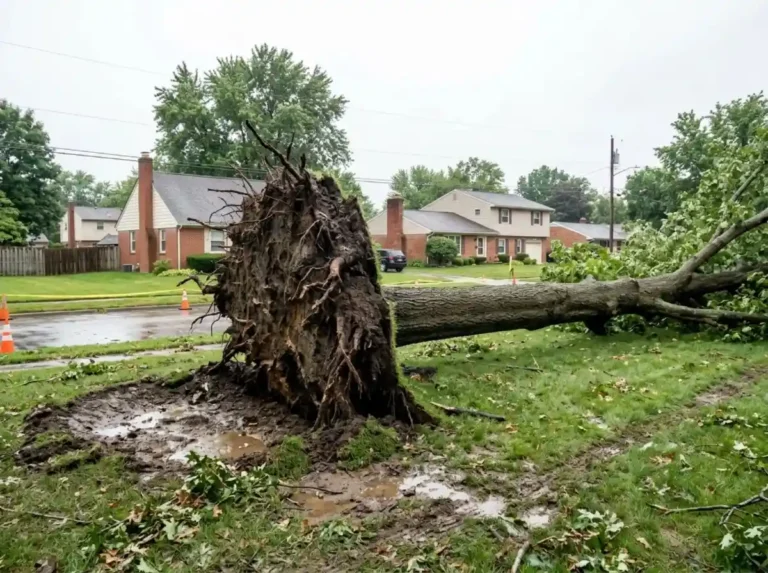
None of these rules are abstract in a city that keeps getting hit. On 11 August 2026, an EF1 tornado with estimated peak winds of 100 mph touched down on South 8th Street about two miles south-southeast of downtown and tracked 1.8 miles east to Bexley in four minutes. The National Weather Service survey recorded broken and uprooted trees along South 8th, damage through the Reeb Avenue area, and west of Fairwood Avenue “one home’s roof caved in due to fallen trees.” No injuries, which was luck.
Five months earlier, on 13 March 2026, a straight-line wind event put measured gusts of 71 mph at OSU Airport, 69 mph at John Glenn (CMH) and 63 mph at Rickenbacker. Neither event needed a tornado to bring trees down across the county.
After a storm the code does not vanish, but the sequence changes: emergency work on a public tree can proceed and the permit follows within 10 business days. For non-life-threatening tree emergencies after hours the city directs you to the Division of Police at 614-645-4545; for everything else, 311 at 614-645-3111. That is also how you report a city tree that needs inspecting or removing — the city removes public trees that are dead, dying or dangerous, at no cost to you, if you get in the queue.
What the city will not do is take the wood away. Columbus yard waste rules are explicit: cut branches to less than four feet in length, tie bundles no more than two feet wide, keep containers to 32 gallons and 50 pounds — and “branches exceeding four inches in diameter cannot be recycled with yard waste and will not be collected.”
Four inches. A single mature limb off a silver maple is thicker than that at the base. Every trunk section from a real removal is thicker than that. There is no bag count limit, which sounds generous until you realise none of the wood you actually need gone qualifies. That is why hauling is not a line item to skim past when you compare quotes — it is most of the job on a removal and nearly all of it after storm damage.
Why the city is being this particular about it
Columbus measured its canopy with Franklin County and found it had grown from 19.6% in 2011 to 22% in 2021 — a net gain of 3,353 acres. The Urban Forestry Master Plan, adopted in 2021, sets the target at 40% citywide, with an interim goal of stopping net canopy loss by 2030. The city puts the annual value of what its trees do at $38 million.
It is also not evenly spread. Twenty-four Columbus communities sit below the 22% citywide figure, with Italian Village and Downtown lowest at roughly 12%. And the number that explains the whole posture of the new code: about 70% of Columbus trees grow on private property, only 30% on public land. The city directly controls its 125,000-plus street trees — so it protects those tightly, gives the permits away free, and spends the rest of its effort persuading the rest of us.
The short version, if you only remember five things
- The tree in your tree lawn is the city’s, decided by where the majority of the trunk sits.
- Touching it — pruning, stump grinding, fertilizing, cabling, herbicide — needs a free Forestry permit, and only a certified arborist can file it.
- Damaging it is priced at $260 per trunk inch, and each day a violation stands is a separate offense.
- Your own back garden needs no permit — unless the tree has been deemed a public nuisance.
- Nothing over four inches thick is going out at the curb, ever.
If you have a tree you are unsure about — whose it is, whether it is a nuisance, whether the work needs a permit before anyone climbs it — that is a short conversation, not a site visit. Call BuckeyeTree at (614) 259-1714 and we will tell you which side of the line it falls on. If it turns out to be a city tree, we will file the permit; if it is yours and it is fine, we will say so.
Sources
- City of Columbus, ordinance 2800-2023, passed 14 December 2023 — repeal and replacement of City Code Chapter 912, Trees and Shrubs
- City of Columbus, Chapter 912 — Trees and Shrubs; Columbus Tree Subcommission (§912.01, §912.02, §912.04, §912.05, §912.06, §912.08, §912.99)
- City of Columbus, Tree Technical Manual, May 2024 (§1.4, §2.1, §3.3, §5.2, §5.3, §5.4, §5.5, §6.1, §8.1)
- Columbus Recreation and Parks, Urban Forestry and Tree Canopy Assessment
- Columbus Urban Forestry Master Plan (2021), canopy goal and equity goals
- City of Columbus, Yard Waste Collection
- NOAA / National Weather Service Wilmington OH, EF1 tornado survey, Columbus, 11 August 2026, and high wind reports for 13 March 2026
- Ohio Revised Code §901.51, injuring vines, bushes, trees or crops on the land of another
- Ohio Administrative Code Rule 901:5-30-01, invasive plant species
One note on verification: the Chapter 912 text quoted here comes from the adopted replacement chapter as published by the city and from the city’s own Tree Technical Manual. We were not able to open the current Municode edition directly to compare wording line by line, so for anything you are about to spend money on, confirm the current text with Forestry on 614-645-3111. Code changes. If the city’s version differs from ours, the city is right and we will correct this page.
Related services in Columbus
Ready to Get Rid of That Stump?
BuckeyeTree Pro — 4466 Morse Rd, Columbus, OH 43230
📞 Call (614) 259-1714 Now