Oak Wilt in Central Ohio: When It Is Actually Safe to Prune an Oak
Almost everything written about oak wilt for Ohio homeowners answers one question — when is it safe to cut an oak — and answers it with a single confident date range. We went looking for where that date range comes from.
It does not exist. Four Ohio State publications give four different windows, two of them inside the same fact sheet, and a fifth Ohio source gives a sixth answer. That is not a reason to ignore the rule. It is a reason to understand what the rule is actually protecting against, so you can make a sensible decision in the weeks where the sources disagree.
This article lays out what Ohio’s own agencies and universities say, where they contradict each other, and what could not be confirmed at all. Everything unverified is marked as such, and there is a section at the bottom listing the gaps.
The window: what Ohio sources actually publish
Here is every Ohio-affiliated source we could find, with the dates each one gives for when not to wound an oak:
| Source | Avoid wounding oaks |
|---|---|
| OSU Ohioline fact sheet PLPATH-TREE-02 | April 15 – July 1 |
| The same fact sheet, stricter alternative | April 15 – October 1 |
| OSU Buckeye Yard & Garden Line, “Is It Oak Wilt, Or Not?” | April 1 – October 15 |
| OSU Buckeye Yard & Garden Line, “OK to prune OAKS…” | April 15 – October 15 |
| Ohio Chapter ISA | Sap beetles most active early March – late July |
Two of those come from the same fact sheet, which offers the narrow window and then adds that you can “avoid wounding the trees throughout the growing season (April 15–Oct. 1).” The two BYGL articles are from the same institution and do not match each other either.
Why the narrow window is probably too narrow for Ohio
The April 15 – July 1 figure has a specific origin, and the USDA Forest Service says so plainly. Its oak wilt publication states that favourable conditions for beetle spread “usually occur between April 15 and July 1 in the Lake States and over a correspondingly longer period of time to the south.”
Ohio is south of the Lake States. That single federal sentence is the best available justification for Ohio using a longer window than Minnesota or Wisconsin — and it is why we would not treat July 1 as an all-clear in Franklin County.
One more thing to know: the widely repeated “April 15 to July 15” rule you will find on many Ohio tree-service pages is Michigan’s. Michigan DNR and MSU publish it. No Ohio source does.
The practical rule
- Do not wound an oak between roughly April 1 and October 15. That is the most conservative Ohio published window and it costs you nothing to follow.
- Treat April 15 through July 1 as the hard core of the danger period. Every Ohio source agrees those weeks are bad. If you have to break the rule, do not break it then.
- The safest time to prune an oak in Ohio is November through February. That is where three separate sources overlap: OSU BYGL gives “October 15th to April 15” in one article and “November 1 and April 1” in another; Ohio Chapter ISA gives “November through February.” The intersection is the defensible answer.
OSU’s reasoning for dormant pruning is worth quoting because it is not only about beetles: “Trees that are pruned before they break bud have less of a likelihood to bleed and attract picnic beetle.” A dormant cut is a drier cut.
A contradiction inside OSU worth knowing about
OSU’s general tree-pruning fact sheet says, verbatim: “In Ohio, this means that pruning should take place in the spring to early summer (March–June).” That is sound advice about wound closure for trees generally — and it is almost exactly the oak wilt danger window.
Both documents are current OSU fact sheets. A homeowner reading the general one and applying it to an oak would prune at the worst possible moment. For oaks, the disease rule wins.
What the calendar is actually protecting against
The window makes far more sense once you know the mechanism, because the mechanism has a clock in it.
The fungus is Bretziella fagacearum. If you find older references calling it Ceratocystis fagacearum, that is not an error — the fungus was moved to a new genus in 2017 after a multi-gene phylogeny showed it did not belong in any genus it had previously been filed under. Same organism, same disease.
It travels two ways, and only one of them involves your saw.
Overland, by beetle
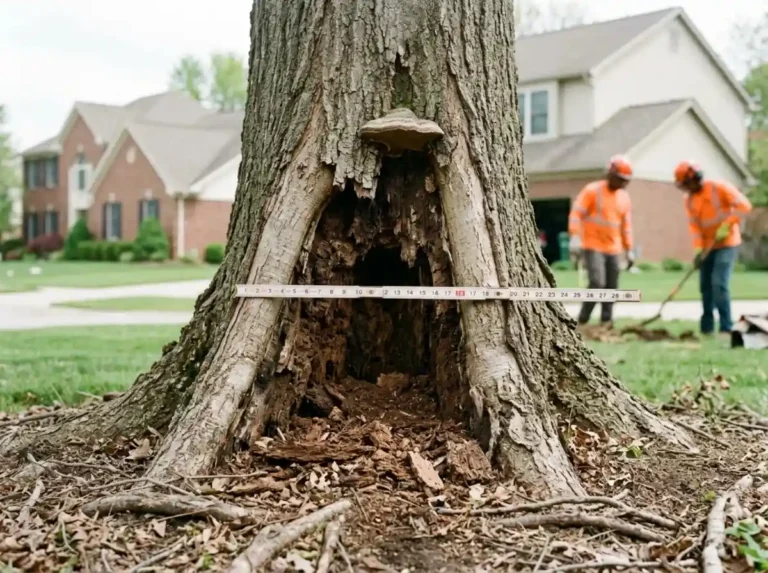
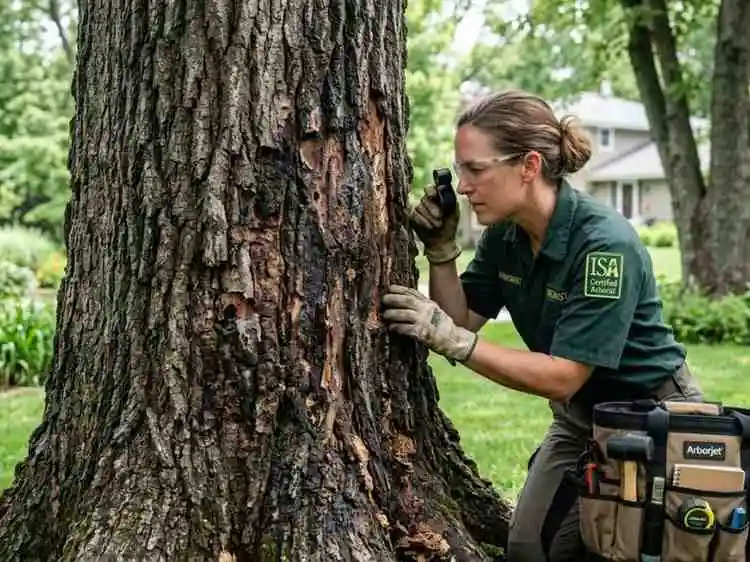
On a tree that died of oak wilt, the fungus grows a mat under the bark and then physically cracks the bark open — OSU’s phrase is that the mats “crack the bark open with pressure pads.” The mats put out an odour the Forest Service describes as “a strong, fruity or wine-like odor.”
That odour brings in sap-feeding beetles — family Nitidulidae, the same “picnic beetles” that show up at a barbecue. The Forest Service is specific about which ones matter: “only Colopterus truncatus, Colopterus semitectus, Carpophilus sayi, and Epuraea corticina are known to carry the oak wilt pathogen to fresh wounds during the critical spring period.”
They leave the mat carrying spores and they go looking for the next thing that smells like sap. That is where your pruning cut comes in. And here is the number that makes the whole rule concrete — OSU, verbatim:
wounds are attractive to Nitidulid beetles only for up to three days.
Three days. That is the entire exposure. A cut made in January is a scab by April. A cut made on the first warm Saturday in May is an open invitation for seventy-two hours.
Two details most articles get wrong. First, mats form “in the fall or spring following the death of the infected tree” — so a red oak killed this August is next April’s spore source, not this one’s. Second, “spore mats usually do not form on trees smaller than 6 inches in diameter at breast height.”
And one correction: the common line that “white oaks don’t form mats” is imprecise. The Forest Service says “most spore mats are produced on trees in the red oak group, but mats can also develop on bur oak. Mats do not form on other trees in the white oak group.” Bur oak is a white-group oak that does form mats.
Underground, through root grafts
Neighbouring oaks fuse roots. Once one tree is infected, the fungus moves through those connections without any beetle involved. The Forest Service puts the reach at “some distance (up to 100 feet or more) from an infected tree.”
Usefully, grafts are mostly within-group: “Root grafts do not commonly occur between trees of different oak species groups, although exceptions occur.” A red oak generally does not graft to a white oak, which changes which neighbours are actually exposed.
Severing the grafts means a trench or a vibratory plow to a depth of about five feet. The Forest Service: “The blade penetrates to a depth of about 5 feet, and cuts through the roots of oaks that may be grafted together. While oak roots may extend deeper than 5 feet in the soil, most root grafts are disrupted by trenching or plowing to that depth.”
The order matters and is routinely reversed. OSU: “Once the trenches are in place, diseased and dead trees should be removed as soon as possible.” Sever the grafts first, then take the tree. Removing a diseased oak before the roots are cut can push the fungus toward its neighbours.
You will see the figure that 90% of new infections travel root-to-root. OSU does state it — “It is estimated that 90 percent of new infections occur between neighboring trees through root grafts” — but it is presented as an estimate with no primary study behind it, and the Forest Service gives no percentage at all. It also gets garbled in retelling. Root grafts spread an existing pocket. Every new pocket still has to start with a beetle on a fresh wound. Both facts are true and they are not in competition.
If an oak gets wounded in the wrong month
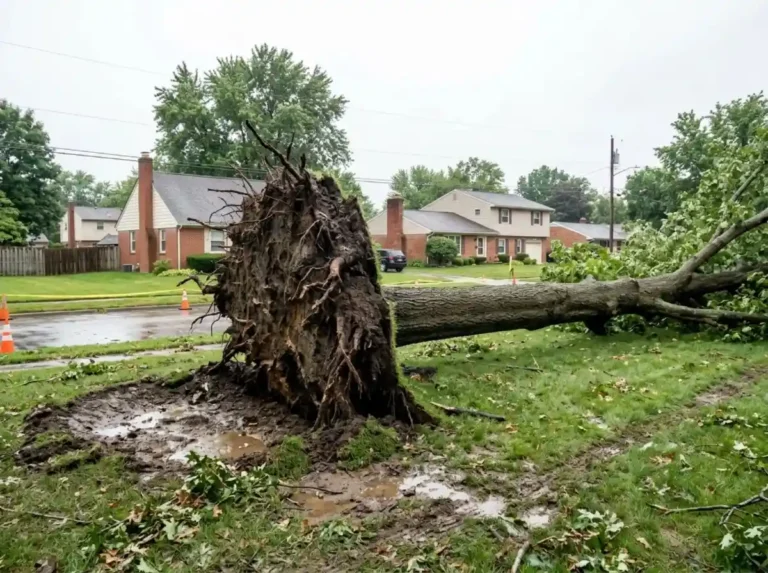
Storms do not read the calendar. Neither do cars, string trimmers, contractors or falling limbs. So what do you do when an oak is torn open in June?
This is the one documented exception to the modern “never paint a pruning wound” rule, and OSU states it in its own pruning fact sheet:
wound painting is no longer recommended, with one exception: in areas where oak wilt disease occurs, wound paints may be useful in preventing insect spread of the oak wilt fungal pathogen.
What to use: ordinary latex paint. OSU says so twice — “dress the wounds. This can be done with latex paint” and “If trees must be pruned for safety reasons during the growing season, it is recommended that the cut surface be covered with latex paint.” Not tar, not asphalt-based pruning sealer.
How fast: immediately. Wisconsin DNR says “immediately after the cut is made.” Ohio Chapter ISA says “within five minutes.” We could not trace that five-minute figure to a primary study, so treat it as the Ohio ISA’s guidance rather than an established research finding — but the direction is not in doubt. Given that a wound stays beetle-attractive for up to three days, sealing it in minutes rather than hours is the whole point.
Keep a can of cheap latex paint and a brush in the garage if you have oaks. It is the least expensive insurance in this entire article.
Is oak wilt actually in Franklin County?
We are going to answer this honestly, because we could not find an official source that confirms it, and several tree-service pages assert it anyway.
Here is what official Ohio material actually says:
- Ohio Forest Health Highlights (2022 and 2023), Ohio Division of Forestry: “New and existing infections were identified in all regions of the state.” No counties are named. The 2022 aerial survey identified 25 oak wilt sites totalling 97 acres statewide.
- Same source, on history: “has been known to occur in Ohio since at least 1950, but there has been a concerning increase in oak wilt infected areas since 2019.”
- OSU Ohioline: “Reported from the majority of the 88 Ohio counties.” No list, no map.
- ODNR has no public oak wilt page at all. Its Forest Health landing page does not mention the disease.
And the most telling item. ODNR convened an Ohio Oak Wilt Working Group in 2022 — in its own words, to “improve the mapping of oak wilt across the state.” The state is saying, in a published document, that its own map is not good enough.
So: we cannot tell you oak wilt is confirmed in Franklin County, and we are not going to imply it. What we can tell you is that it is present in every region of Ohio, in most of its 88 counties, and increasing since 2019 — and that “the majority of counties” and “all regions” is more than enough reason for a Columbus homeowner to prune oaks in winter rather than June. The rule costs nothing. Guessing at a county map costs credibility.
If you want a definite answer for your own tree, there is only one: a lab test. See below.
Which oaks are at risk, and how fast
Oaks split into two groups and the difference is dramatic. OSU:
| Group | Central Ohio species | What happens |
|---|---|---|
| Red / black oak group | pin oak, northern red oak, black oak, scarlet oak, shingle oak, shumard oak | “extremely susceptible and can die within a few weeks of infection” — the Forest Service records mortality “within 3 weeks” under some conditions |
| White oak group | white oak, bur oak, swamp white oak, chinkapin oak | “more tolerant… may survive infection for one or more years while displaying decline symptoms” — dying “slowly, one branch at a time” |
Now look at which tree Central Ohio planted by the thousand in post-war subdivisions and along tree lawns: pin oak. It sits in the fast group. A pin oak that picks up oak wilt in late spring can be dead before Labor Day.
That is the local hook, and it is the reason the pruning window is not an abstract forestry concern in this region. If you live in Worthington, Upper Arlington, Bexley or any of the older inner-ring suburbs, you are probably looking at pin oaks right now.
What oak wilt looks like
The Forest Service gives the most precise description available for red oaks:
Often the initial symptom is a subtle off-green color shift… Shortly after this initial color shift, the leaves begin to wilt from the top of the crown downward… individual leaves quickly discolor, taking on a bronzed appearance. The discoloration progresses around the margins of the leaf from the tip to the base.
OSU’s Buckeye Yard & Garden Line puts the same thing in kitchen-table language: leaves “turn brown from the tips, inward to the base of the leaf… like if you dipped it partially in milk chocolate,” and whole limbs wilt in a pattern called flagging that “looks like fall in the middle of summer.”
Timing: “If infections occur in late spring, trees usually begin wilting in mid- to late summer.” Which is to say — late August is exactly when this becomes visible in Central Ohio.
The single most reliable signature is rapid leaf drop. Leaves that are still half green, going bronze from the edges, falling off the tree in July or August. Hold onto that, because the next section turns on it.
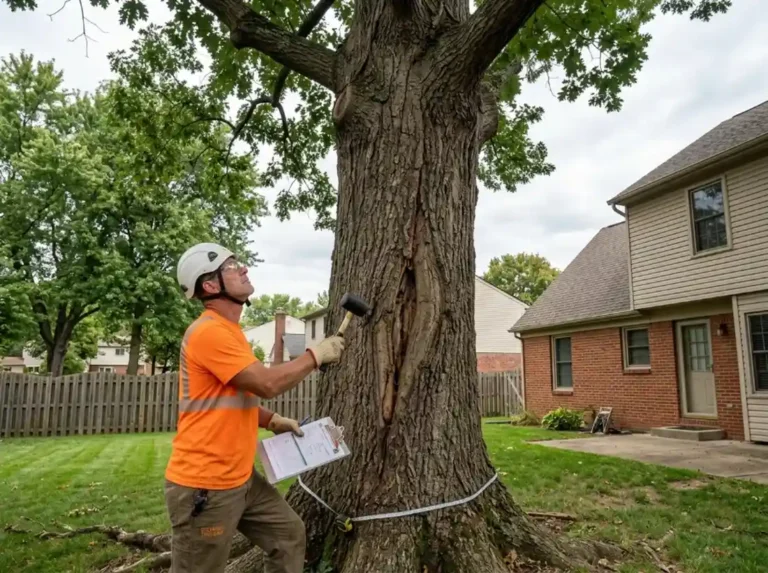
One caution: sapwood streaking under the bark is, in OSU’s words, “a good, but insufficient, diagnostic character.” It supports a diagnosis. It does not make one. And veinal necrosis, which you will read about in oak wilt articles, is a Texas live oak symptom — not an Ohio one.
What it usually turns out to be instead
Most brown oaks in Central Ohio are not oak wilt. OSU names the usual suspects — “drought conditions… construction damage including root injury, insect pests, other diseases including anthracnose, bacterial scorch and root rot” — but does not explain how to tell them apart. Here is the part that does.
Oak decline and the two-lined chestnut borer — and the test that separates them
This is the most useful single fact in this article, and it is the exact reverse of what most people assume. Minnesota DNR, verbatim:
A key symptom of decline in oaks, especially those in the red oak group, is that dead leaves remain on the branches for months.
That clinging-dead-leaves pattern is what distinguishes oak decline and two-lined chestnut borer attack from oak wilt. So:
- Leaves falling off fast, still partly green — consistent with oak wilt.
- Brown leaves hanging on for weeks or months — points away from oak wilt, toward decline, drought stress, root damage or borers.
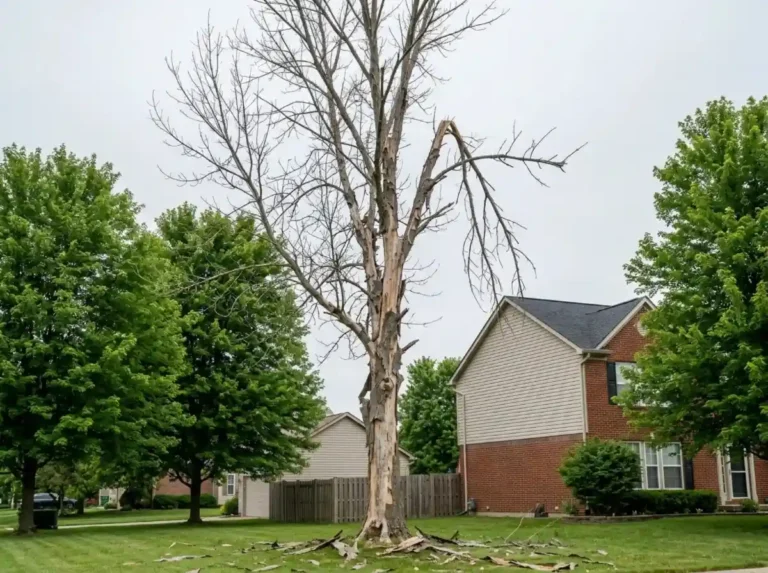
Two-lined chestnut borer leaves D-shaped exit holes and winding galleries under the bark, and its damage typically shows “from mid-July to mid-August.” But do not let that close the case — Minnesota DNR warns explicitly: “the presence of exit holes and galleries does not necessarily mean that twolined chestnut borer killed the tree.” Borers move into oaks that oak wilt already killed.
Bacterial leaf scorch
Caused by the bacterium Xylella fastidiosa and spread by leafhoppers, not beetles. The tell is a band of colour between the dead margin and the living tissue — “a pronounced marginal discoloration with a dull red or yellow halo between scorched and green tissues” — and the timing: “Symptoms first appear in late summer to early fall.”
The bigger difference is the pace. Bacterial leaf scorch comes back and worsens over years. Oak wilt kills a red oak in weeks. If your oak has looked scorched every August for four summers running, that is not oak wilt.
Pin oak chlorosis — and an honest correction
Chlorotic pin oaks are a familiar sight in Columbus: pale yellow leaves with the veins still green, across the whole canopy, coming back year after year without killing the tree. Up close it looks nothing like oak wilt. At a distance, in a panic, people confuse the two.
The standard explanation is “Central Ohio has high-pH soil, so pin oaks cannot take up iron.” That explanation is shakier than it sounds, and we are not going to repeat it as fact.
- Franklin County’s dominant soils — Crosby and Bennington — are described in their USDA-NRCS Official Series Descriptions as “strongly acid to neutral” in the surface and rooting horizons. Carbonates sit 20 to 60 inches down, below where most feeder roots work.
- The peer-reviewed study most directly on point — Watson & Himelick (2004), Arboriculture & Urban Forestry — reported that “A relationship between chlorosis and soil pH or fine root development could not be established for pin oaks.”
What is well supported is that the region sits on calcareous glacial till in a “high-lime till plains” ecoregion, on heavy, somewhat poorly drained clay — and that disturbed urban soil is a different animal from the natural profile. Construction backfill, limestone gravel, and mortar and concrete rubble along foundations, sidewalks and tree lawns can raise pH locally, and street-tree planting pits restrict rooting volume badly.
So the honest version: chlorosis in Columbus pin oaks is real, and disturbed-soil chemistry plus cramped rooting space is the likely mechanism — but we could not find a Columbus-specific study measuring it, and the simple soil-pH story does not survive contact with the research. Anyone who tells you otherwise with confidence has not checked.
Getting an actual answer
OSU is blunt about this: “Conclusive diagnosis can only be made in specialized laboratories, such as The Ohio State University C. Wayne Ellett Plant and Pest Diagnostic Clinic.”
| Lab | C. Wayne Ellett Plant and Pest Diagnostic Clinic, OSU Department of Plant Pathology, 234 Selby Hall, 1680 Madison Avenue, Wooster, OH 44691 |
| Contact | 330-263-3721 · ppdc@osu.edu |
| Cost | Basic Plant Health Analysis $30, plus nested PCR for oak wilt $40 |
| Sample | “Select 5 or 6 branches that are about the diameter of your index finger (about 1 inch) and cut them to about 8-12 inches long”, from wood “that ha[s] a good transition from dying to living tissue”, bagged in plastic to stay moist, shipped next-day, with a completed Plant Diagnostic Form |
One correction on cost: OSU’s own BYGL article still quotes “$20 fee for the test.” The clinic’s current published fee schedule does not — it lists $40 for the oak wilt nested PCR, on top of the $30 basic analysis. Budget for the current numbers, not the ones in the article. Turnaround time is not published anywhere we could find — ask when you call.
Avoid shipping into a weekend. The sample needs to arrive alive.
Treatment: what the research says versus what gets sold
There is one fungicide in this conversation — propiconazole, sold as Alamo, delivered by macroinjection. OSU calls it “the only scientifically tested systemic fungicide showing any efficacy and labeled for use against oak wilt.” That is a real endorsement and it is also a narrow one.
- It is preventive, not curative. OSU: it has “virtually no hope of succeeding in infected red oaks.” A University of Minnesota review: “Therapeutic treatments in susceptible red oak species are relatively ineffective, especially during advanced stages of crown wilt.”
- The protection is short. “The protection provided by propiconazole is believed to last for no more than two years”, and re-treatment within two growing seasons is needed to sustain it.
- It has not been shown to stop root-graft spread. The same review reports that “Injections of propiconazole were ineffective in preventing the transmission of C. fagacearum through root grafts” and concludes “There is currently no proven mechanism by which propiconazole would act to prevent root graft transmission.” That matters, because protecting the neighbours of an infected tree is exactly the pitch it is usually sold on.
- The field results are modest. A USDA Forest Service research note followed 46 red oaks across 29 sites in the Twin Cities. Eighteen of the 46 treated trees developed oak wilt anyway. The authors’ own summary: preventive macro-infusion “provides limited suppression of oak wilt spread via root grafts.”
- The spectacular numbers are from a different tree. The 97–100% efficacy figures that circulate come from Texas live oaks. Different host, different disease dynamics. They do not transfer to an Ohio pin oak.
The blunt reading: injection is a defensible spend on a high-value, currently healthy oak near a confirmed infection, repeated every two years, with realistic expectations. It is not a rescue for a red oak that is already wilting. Anyone selling it as one is selling you the Texas numbers.
The wood is the part people get wrong
A red oak that dies of oak wilt this summer is not finished causing problems. It becomes next spring’s spore factory unless it is dealt with.
The Forest Service sets the deadline: “Trees that die in summer should be removed and treated before the following spring… If the wood is sufficiently dried, however, spore mats will not develop.” The accepted treatments are “debarking, chipping or splitting, and drying the wood.”
If you are tarping it, do it properly — and note the detail that almost every retelling drops. Forest Service: “Covering dead wood with plastic, burying the edges for 6 months, and then air drying for a similar time will kill the fungus and any associated insects.” OSU specifies 4 mil plastic and says the wood can be safely uncovered at the end of the second season. Throwing a tarp loosely over a woodpile is not the recommendation.
The practical test for when oak firewood is safe: loose bark. Wisconsin DNR — “Wood from dead trees with loose bark, and from apparently healthy trees with no wilting symptoms, does not pose a risk for the spread of oak wilt.” No bark, no mat substrate.
Two honest notes. First, Ohio has no oak wilt quarantine. We checked the National Plant Board’s Ohio regulatory summary and USDA APHIS — Ohio’s regulated pests are Asian longhorned beetle, spongy moth, hemlock woolly adelgid, spotted lanternfly and box tree moth. Oak wilt appears nowhere. So “don’t move firewood” is advisory here, not law — though firewood is legally restricted in Ohio under the ALB and spongy moth quarantines, so the advice holds for other reasons. Second, we found no source addressing whether oak wilt wood can be milled into lumber. The drying principle suggests it is fine; nobody official says so. We are not going to fill that in.
What Columbus requires — and what it does not
The city rewrote its tree code recently, and we went through the whole thing in our walkthrough of the Chapter 912 rewrite. Three points bear directly on oaks.
1. Pruning a public tree needs a permit. Section 912.05(A): “No person shall plant, set out, or engage in the maintenance of any tree or shrub by removal, stump grinding, application of herbicide or other chemicals, fertilizing, bracing, cabling, pruning, surgery work, cutting above or below the ground, or cutting of roots in a public street, park, or public space without first obtaining a permit issued by the department.” That covers the tree lawn — and whether a given tree is a street tree depends on which municipality you are actually in, which is not always the same as your mailing address.
2. You cannot pull that permit yourself. The Columbus Tree Technical Manual: “The Property Owner must hire a Certified Arborist, who will in turn apply for the Forestry Permit.” Work on public trees must follow ANSI A300 Part 6 pruning standards.
3. The city imposes no seasonal pruning restriction, and its tree code never mentions oak wilt. We read both Chapter 912 and the Tree Technical Manual. Neither contains a single date restriction on when pruning may occur, and neither names oak wilt, Dutch elm disease or wound dressing anywhere. The oak wilt calendar is a horticultural rule, not a Columbus ordinance — which means nobody is going to stop you pruning an oak in June. That is exactly why it is worth knowing.
On private property, nothing we found requires a permit to prune your own oak.
Six ways to make it worse
- Prune an oak in the growing season and leave the cut open. Three days of exposure per wound.
- Leave a dead red oak standing through the winter with its bark on. Mats form the spring after death. That is your neighbour’s tree next.
- Remove the diseased tree before severing the root grafts. OSU sequences it the other way round for a reason.
- Move the firewood. Advisory in Ohio, and still the single easiest way to start a new pocket somewhere else.
- Diagnose by eye and treat instead of testing. Sapwood streaking is “insufficient.” Borer holes do not rule oak wilt out.
- Inject a red oak that is already wilting and consider the matter closed. Meanwhile the root grafts keep working.
Who to call
There is no Ohio oak wilt hotline and no state reporting portal. These are the real contacts:
| What you need | Who |
|---|---|
| A confirmed diagnosis | OSU C. Wayne Ellett Plant and Pest Diagnostic Clinic — 330-263-3721, ppdc@osu.edu |
| General horticultural help, Franklin County | OSU Extension Franklin County — 614-866-6900. The Master Gardener Garden Information Helpline takes email at fcmg@osu.edu, Mondays noon–3pm and Fridays 9am–noon. |
| Forestry advice on wooded property | ODNR Division of Forestry service forester for District 13, which covers Franklin, Licking and Muskingum counties. Staff assignments change — look up the current service forester on ODNR’s site rather than trusting a name in any article, including this one. |
| Anything involving a street or park tree in Columbus | City of Columbus Forestry — 311, 614-645-6640, Forestry@columbus.gov |
If what you are looking at is a large oak that needs work and you would rather it happened in the right month, that is our end of it. We schedule oak work into the dormant season by default, we assess what is actually wrong with a declining tree before recommending anything, and if a tree does have to come out we will tell you why. Tell us what you are seeing.
The last time a single organism rewrote Central Ohio’s canopy, it was the emerald ash borer, and two decades on we are still clearing the standing dead from it. Oak wilt is not moving at that speed. It does not need to.
What we could not verify
- Whether oak wilt is confirmed in Franklin County. ODNR and the Forest Service say “all regions of the state” and name zero counties. OSU says “the majority of the 88 Ohio counties” with no list. The USDA county-level map is a raster image last updated in 2019 and the Forest Service story map is an interactive app; neither yielded readable county data. The only county-specific Franklin claims we found were on commercial pages.
- Which Ohio pruning window is authoritative. Five sources, five answers. We showed all five rather than picking one silently.
- The “paint within five minutes” figure. Ohio Chapter ISA publishes it. We could not trace it to a study. Wisconsin DNR says “immediately.”
- Any Ohio pruning window for elms. OSU’s Dutch elm disease fact sheet gives no dates at all, and neither do Minnesota’s or Wisconsin’s. The dormant-season logic applies on principle, but no Ohio source states a rule. Where a hard date ban exists it is Saskatchewan’s, not Ohio’s.
- A Columbus-specific study of urban soil pH and pin oak chlorosis. None found. The mechanism is plausible; the local measurement does not appear to exist publicly.
- OSU diagnostic clinic turnaround time. Not published.
- Whether oak wilt wood can safely be milled. No source addresses it.
- A distinguishing description for anthracnose. OSU names it as a look-alike but does not say how to tell it apart, and we found no Ohio source that does.
Sources
- OSU Ohioline PLPATH-TREE-02 — Oak Wilt
- OSU Ohioline PLPATH-TREE-06 — Pruning and Care of Tree Wounds (the wound-paint exception)
- OSU Buckeye Yard & Garden Line — “OK to Prune Oaks”, “Is It Oak Wilt, Or Not?”, and the pruning-window article
- USDA Forest Service, “How to Identify, Prevent, and Control Oak Wilt” (NA–FR–01–11)
- Ohio Forest Health Highlights 2023 and 2022, Ohio Division of Forestry
- Ohio Chapter ISA — Oak Wilt
- Wisconsin DNR — Oak Wilt
- Minnesota DNR — Identifying Oak Decline (the clinging-leaves distinction)
- APSnet — Bacterial Leaf Scorch
- Eggers, Juzwik, Bernick & Mordaunt (2005), “Evaluation of propiconazole operational treatments of oaks for oak wilt control,” USDA FS Research Note NC-390
- Blaedow (2009), “Use of the Systemic Fungicide Propiconazole for Oak Wilt Management,” University of Minnesota
- Watson & Himelick (2004), “Effects of Soil pH, Root Density, and Tree Growth Regulator Treatments on Pin Oak Chlorosis,” Arboriculture & Urban Forestry 30(3): 172–178
- de Beer et al. (2017), “Bretziella, a new genus to accommodate the oak wilt fungus,” MycoKeys 27: 1–19
- OSU C. Wayne Ellett Plant and Pest Diagnostic Clinic — fees and wilt-disease sampling instructions
- City of Columbus, Chapter 912 revision (final, October 2023) and Columbus Tree Technical Manual (May 2024)
- National Plant Board — Ohio Summary of Plant Protection Regulations (25 February 2026)
- USDA-NRCS Official Series Descriptions — Crosby and Bennington