A Tree Just Came Down. Who Do You Call in Columbus?
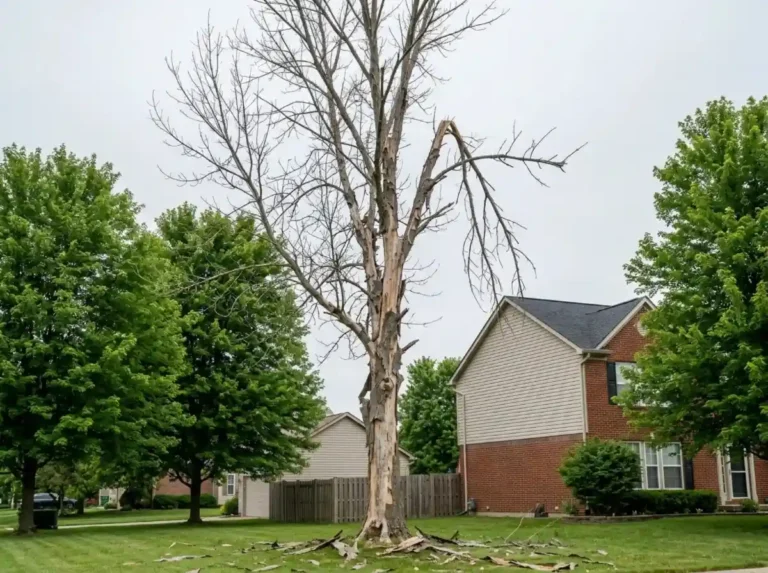
A tree comes down at two in the morning and the first question is never “who do I hire.” It is “who is responsible for this, and who do I phone right now.” The answer changes depending on where the tree stood, where it landed, and what it is touching — and getting the order wrong can cost you money or worse.
Here is the order we would work through it, with the actual numbers and the rules behind them.
First question: is anything touching a power line?
Nothing else matters until this is settled. If a tree or limb is on a line, or a line is on the ground, call AEP Ohio on 800-672-2231. If anyone is hurt or in danger, 911 first.
AEP Ohio’s own wording on this is not gentle, and it should not be:
“You should never attempt to cut back or remove trees near our power lines — serious injury or even death can occur.”
AEP Ohio, Report a Tree Problem
And OSHA sets a hard distance that is worth memorising:
“All tree trimming or removal work within ten feet of a power line must be done by trained and experienced line-clearance tree trimmers.”
OSHA 3301-12-05, Tree Trimming Safety
Ten feet. Not touching — within ten feet. And from OSHA’s guidance on downed wires: “Do not assume that a downed power line is safe simply because it is on the ground or it is not sparking,” and “electricity can spread outward through the ground in a circular shape from the point of contact.” Stay well back and keep others back.
The service drop is the part people get wrong
There is a difference between the main line running along the street and the service drop — the single line from the pole to your house. AEP Ohio does not maintain vegetation around service lines. If work needs to happen near yours, AEP’s published instruction is to call 800-672-2231 and their Customer Solutions team will schedule a crew to disconnect the service line first.
That is the correct sequence: AEP disconnects, then the tree work happens, then AEP reconnects. Any company willing to work a tree off a live service drop is telling you something about how they operate.
One honest note: AEP Ohio’s own published pages are not perfectly consistent about which portion of the line the customer owns versus the utility. The general position is that AEP owns the service line and the meter while you own the weatherhead, riser, meter socket and everything past the meter — but one AEP page adds that some customers own their service line. For your specific address, ring 800-672-2231 and ask rather than relying on any website, ours included.
Second question: is it blocking a road?
Who to call depends entirely on who maintains that stretch of road.
| Where it is | Who to call |
|---|---|
| Anyone in danger, traffic hazard right now | 911 |
| City of Columbus street | 311 — (614) 645-3111, or 311@columbus.gov |
| City street, after hours | Columbus Division of Police — (614) 645-4545 |
| Unincorporated Franklin County road | Franklin County Engineer — 614-525-3030 |
| County road, after hours | 24-hour Road & Bridge — 614-525-3072 |
| State route or interstate | #677 (Ohio State Highway Patrol) or ODOT District 6, 740-833-8000 |
The Franklin County Engineer’s Office publishes its scope plainly: “The Franklin County Engineer’s Office removes trees, tree limbs, and other brush that inhibits the right of way and causes visual obstructions to the roadway.” They maintain 250 miles of county roadway.
For city trees, Columbus Recreation and Parks states that “Forestry staff are on call 24 hours a day to respond to tree-related emergencies.” That is the 311 route during the day and the Police non-emergency line after hours.
An honest gap: we looked for a Columbus Department of Public Service page dealing with fallen trees or roadway debris and could not find one. Their published FAQ covers potholes, sidewalks, traffic signals and street signs only. The tree-emergency routing above comes from Recreation and Parks, which is the department that actually publishes it.
Third question: whose tree was it?
If it stood in the tree lawn — the strip between the sidewalk and the kerb — it is almost certainly the city’s, not yours. That strip is public right-of-way. Where a trunk straddles the line, the city’s Tree Technical Manual settles ownership by trunk position: the tree is the city’s if the majority of the trunk sits on city land.
That matters in both directions. The city removes public trees that are dead, dying or dangerous at no cost to you, if you report them. But it also means you cannot simply hire someone to clear a city tree off your driveway without the paperwork catching up with you. We wrote about that in detail in our piece on the rewritten Chapter 912, and about how the answer changes across suburb lines in who is responsible for the tree in your tree lawn.
Report a city tree — down, damaged or dangerous — through 311 on (614) 645-3111.
If it came out of your neighbour’s yard
This is the question that causes the most arguments on the street, and the honest answer is uncomfortable.

We are not lawyers and this is not legal advice. Liability for a falling tree in Ohio turns on specific facts about the tree’s condition and what its owner knew. What follows is the general rule as Ohio courts have stated it — your situation may come out differently and a solicitor is the person to ask.
The controlling case is Heckert v. Patrick, 15 Ohio St.3d 402 (1984). Its starting position:
“Land owners do not owe a duty with regard to harm caused to another as a result of some natural condition of the land, provided that the harm occurs outside of the land.”
Heckert v. Patrick, 473 N.E.2d 1204, 1206
In plain terms: a healthy tree that comes down in a storm is usually nobody’s fault. Your own insurer handles your damage, and the neighbour is generally not liable. Insurers often call that an act of God.
But the whole thing pivots on one word: notice. The same case draws a distinction between rural and urban land, and Columbus is urban:
“an owner of land having actual or constructive knowledge of a patently defective condition of a tree which may result in injury… must exercise reasonable care.”
Heckert v. Patrick, as quoted in Stevens v. Jeffrey Allen Corp.
Ohio State University Extension puts the practical test the same way — a neighbour may be liable “if the neighbor had knowledge that the tree was diseased, weak, or ‘patently dangerous,'” and if the tree was sound or the owner knew nothing of its condition, “the law would not likely create liability.”
So if you are looking at a visibly dead or split tree next door right now, the useful move is not to argue about it — it is to create a record. A dated letter, a photograph, and where the stakes justify it a written arborist assessment. Documented notice is the thing that separates “act of God” from “you were told.”
Overhanging branches — you may cut, but only to the line
Ohio follows the self-help rule. From Rababy v. Metter, 2015-Ohio-1449:
“A privilege existed at common law, such that a landowner could cut off, sever, destroy, mutilate, or otherwise eliminate branches of an adjoining landowner’s tree that encroached on his land.”
Rababy v. Metter, 2015-Ohio-1449, ¶14
The same case confirms that for ordinary falling leaves and debris from a neighbour’s tree, “the sole remedy… is the common law remedy of self-help.” You clean it up. That is the law.
Now the sharp edge. Cut past the property line, or trim so hard you kill the tree, and Ohio Revised Code 901.51 applies: “No person, without privilege to do so, shall recklessly cut down, destroy, girdle, or otherwise injure a vine, bush, shrub, sapling, tree, or crop standing or growing on the land of another.” Whoever violates it “is liable in treble damages for the injury caused.”
Three times the value of a mature tree, on top of the criminal penalty. This is the single best reason not to settle a boundary tree with your own chainsaw on a Saturday.
What your insurance actually covers
Before you move anything, the Ohio Department of Insurance is emphatic:
“Before removing debris or broken belongings, document your losses to provide to your insurance company. Take photos and/or video.”
Ohio Department of Insurance, Severe Weather Toolkit
Photograph everything first. It costs two minutes and it is the difference between a paid claim and an argument.
The broad shape of the coverage, from the Insurance Information Institute:
- If a tree hits your house or another insured structure such as a detached garage, standard homeowners policies cover the damage to the structure and its contents.
- Where it hits an insured structure, there is also coverage for removing the tree — “generally up to about $500 to $1,000, depending on the insurer and the type of policy.”
- “If the fallen tree did not hit an insured structure, there is generally no coverage for debris removal.” Some insurers make an exception where the tree blocks a driveway or a disabled-access ramp.
- Where a neighbour’s tree caused the damage, your insurer may pursue theirs through subrogation — which the III notes “sometimes occurs if the tree was in poor health or not properly maintained.” If it succeeds, you may get your excess back.
That third point is the one that surprises people every storm season. A large tree that fell entirely in your garden, hitting nothing, is usually a removal bill you pay yourself.
Two caveats we will not paper over. The III’s $500–$1,000 figures come from press releases and are dated — treat them as typical, and read your own declarations page. And the Ohio Department of Insurance says a tree falling on a fence is covered, while the III frames coverage around insured structures; fences usually sit under “other structures” cover. Check your own policy rather than either summary. The Ohio Department of Insurance consumer hotline is 800-686-1526.
Will the city take the wood away?
Some of it. Not the part you actually need gone.

The Division of Refuse Collection’s published rules set the limits precisely:
“Twigs and branches shall be bundled and tied with string or twine. Bundles shall not exceed four (4) feet in length and two (2) feet in diameter or fifty (50) pounds in weight. No trunk, branch or limb shall exceed four (4) inches in diameter.”
Columbus Division of Refuse Collection, Rules and Regulations, §3.G.7.f
Four inches. Every trunk section from a real failure is thicker than that, and so is the base of most limbs worth calling about.
Then the rule that decides the rest of it:
“Entities providing yard waste cutting and pruning services on public or private property are responsible for the removal and disposal of said yard waste.”
Columbus Division of Refuse Collection, Rules and Regulations, §3.G.7.h
If a company cut it, that company hauls it. The city will not collect a contractor’s debris from your kerb at any size. So when you compare quotes after a storm, haul-away is not a line item to skim — on a removal it is most of the job, and after storm damage it is nearly all of it. A cheap quote that leaves the wood behind is not a cheap quote.
One thing we could not confirm: we searched for a special City of Columbus storm-debris collection programme, separate from ordinary yard waste, and found none published. If the city stands one up after a major event it will be announced at the time. Be careful with articles you find online about “Columbus” waiving tree-debris fees after a storm — several of the prominent ones are about Columbus, Georgia.
If emergency work has to touch a city tree
Columbus does not expect you to wait for paperwork while a tree is on your roof. The Tree Technical Manual defines emergency maintenance as work that “must occur within three days of an incident due to health or safety reasons,” and for a property owner whose emergency repair affects a public tree:
“In the case of Emergency Maintenance, Property Owners must apply for a Forestry Permit within 10 business days of the repair. Property Owners should notify Forestry as soon as an emergency impacts a Public Tree.”
Columbus Tree Technical Manual, May 2024, §3.3c
Ten business days after the fact — not never. A certified arborist files it. That is part of what you are hiring when you call a company that does this properly.
Please do not cut it yourself
We would say this even if we did not do the work for a living, because the numbers are not close.
The CDC: “Each year, approximately 36,000 people are treated in hospital emergency departments for injuries from using chain saws.”
And among people who do this professionally — trained, equipped, insured — a CDC/NIOSH review of tree care work recorded 1,285 worker deaths over 1992–2007, about 80 a year. The most common causes were “being struck by or against an object (42% of deaths), most commonly a tree or branch; falls to a lower level (34%); and electrocutions (14%).”
The specific hazard in storm work is stored tension. A fallen tree is not at rest — it is a bent spring holding load in places you cannot see. The CDC’s warning is blunt about how little it takes:
“a seemingly small tree or branch (2 inches in diameter, for example) may pose a hazard when it is released from tension.”
CDC, Chain Saw Safety
Two inches. A branch you would not think twice about. The CDC also puts bystanders “at least 2 tree lengths (at least 150 feet) away from anyone felling a tree and at least 30 feet from anyone operating a chain saw to remove limbs” — distances most gardens cannot provide.
Clearing small brush you can lift is one thing. A trunk under load, anything above head height, and anything within ten feet of a wire is not a homeowner job on any day, least of all the morning after a storm.
The numbers to keep
| Situation | Call |
|---|---|
| Anyone injured or in immediate danger | 911 |
| Tree or limb on a power line, downed wire | AEP Ohio 800-672-2231 |
| City tree down, damaged or dangerous | 311 — (614) 645-3111 |
| City tree emergency, after hours | Columbus Police (614) 645-4545 |
| Unincorporated county road blocked | 614-525-3030 · after hours 614-525-3072 |
| State route or interstate | #677 · ODOT D6 740-833-8000 |
| AEP Ohio non-emergency tree concerns | 614-883-6987 |
| Insurance questions, Ohio consumers | Ohio Dept. of Insurance 800-686-1526 |
| The tree itself — removal, and hauling it away | BuckeyeTree Pro (614) 259-1714 |
If you are standing in the garden right now looking at something that came down and you are not sure which line of that table you are on, call us on (614) 259-1714 and describe it. We will tell you honestly which of those numbers to ring first — and if the right answer is 311 because it is the city’s tree and the city will take it away free, we will say so. Emergency work is what we do, but we would rather send you to the right place than sell you something you should not be paying for.
Sources
- AEP Ohio, Report a Tree Problem; Ohio Consumers’ Counsel, Utility Line Clearing and Tree Trimming
- OSHA, Tree Trimming Safety (3301-12-05) and Working Safely Around Downed Electrical Wires
- Franklin County Engineer’s Office; ODOT District 6; OHGO / Ohio State Highway Patrol #677
- Columbus Recreation and Parks, Urban Forestry; Tree Technical Manual, May 2024 (§1.4, §3.3b, §3.3c)
- Columbus Division of Refuse Collection, Rules and Regulations (§3.G.7.f, §3.G.7.h)
- Heckert v. Patrick, 15 Ohio St.3d 402, 473 N.E.2d 1204 (1984), as quoted in Stevens v. Jeffrey Allen Corp.; Rababy v. Metter, 2015-Ohio-1449; Ohio State University Extension, Agricultural & Resource Law Program
- Ohio Revised Code §901.51
- Ohio Department of Insurance, Severe Weather Toolkit; Insurance Information Institute, information on insurance for fallen trees
- CDC, Chain Saw Safety; CDC/NIOSH MMWR, Work-Related Fatalities Associated with Tree Care Operations, 1992–2007
How this page was written: everything in quotation marks came from the document named beside it. The liability section describes general Ohio rules as courts have stated them — it is not legal advice and outcomes are fact-specific. Four things we could not confirm are flagged in the text rather than guessed at: any Columbus Public Service page on roadway tree debris, any special city storm-debris programme, any Columbus cleanup tonnage figure, and AEP Ohio’s own inconsistency about service-line ownership. Rules and phone numbers change. For anything that carries a cost, confirm with the office listed — and if an official source contradicts this page, that source is right and we will correct it.
Related services in Columbus
Ready to Get Rid of That Stump?
BuckeyeTree Pro — 4466 Morse Rd, Columbus, OH 43230
📞 Call (614) 259-1714 Now