What Central Ohio Windstorms Actually Do to Trees (and Why They Uproot Instead of Snapping)
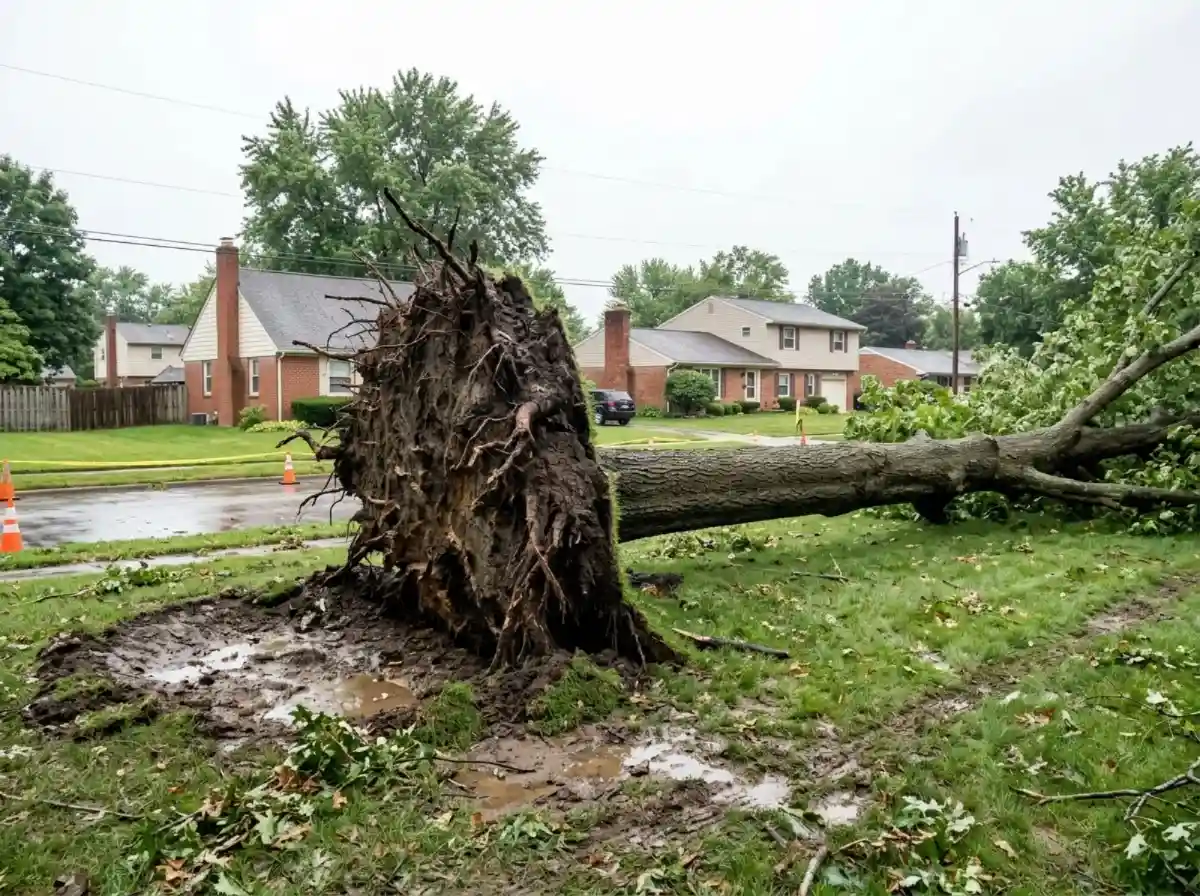
Two dates tell you most of what you need to know about wind and trees in central Ohio. On 29 June 2012, the derecho that crossed southern Ohio produced an 82 mph gust at the Columbus airport. On 11 August 2026, another storm produced an 82 mph gust at John Glenn Columbus International and left more than 130,000 AEP Ohio customers without power. In between, in March 2026, a windstorm with gusts to 70 mph caused what AEP described as its worst damage to electrical infrastructure in more than a decade.
The pattern in the damage surveys
When the National Weather Service surveys storm damage in Franklin County, the language is consistent. The survey of the EF1 tornado that tracked from south-west of Hilliard to south-west of Upper Arlington on 28 February 2024 documented “a consistent mix of snapped trees, uprooted trees” along a 3.8 mile path with maximum winds of 110 mph. The survey of the EF0 that struck Obetz on 30 March 2025, with maximum winds of 85 mph, recorded uprooted trees at the point of strongest wind.

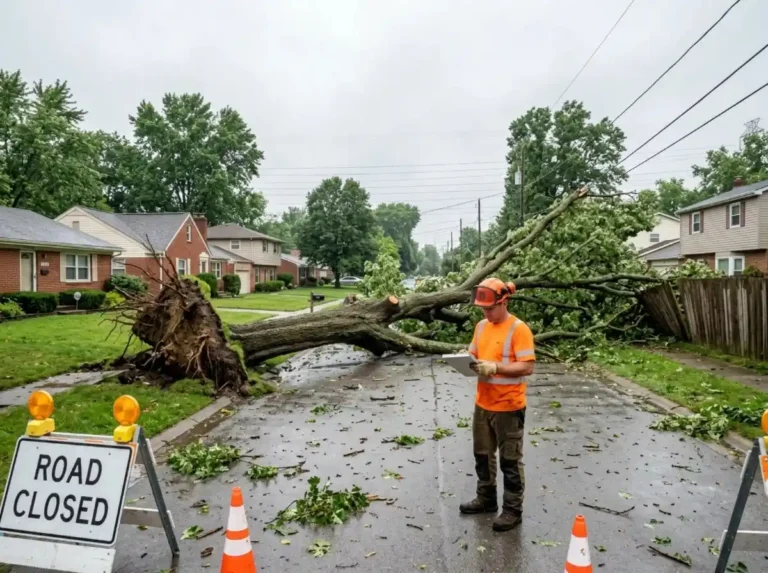
Uprooting is worth paying attention to. A snapped trunk usually means the wood failed. An uprooted tree means the soil failed — the whole root plate levered out of the ground with the tree still intact on top of it. That is a different problem, and it is much more common here than most homeowners expect.
What the ground is doing
West of the Olentangy River, Franklin County soils are dominated by the Crosby and Celina series, with Miamian and Celina on the sloping ground. The Crosby series is officially classified as somewhat poorly drained. Through winter and spring it carries a perched water table roughly half a foot to two feet below the surface, sitting on a dense glacial till layer that restricts water movement.
For a tree, that combination is limiting in a specific way. Roots will not thrive in saturated soil and they cannot penetrate the dense till underneath it. So instead of anchoring deep, the root plate spreads wide and shallow. On a still day that is fine. Put a 70 mph gust against a full canopy on ground that is already saturated from spring rain, and the anchorage simply is not there.
Which trees are most exposed
- Trees that grew up in a group and were later left standing alone — they never developed the taper and root spread of an open-grown tree, but they now take the full wind load.
- Trees with a heavy one-sided canopy, particularly where a neighbouring tree has been removed.
- Anything with a lean that has increased over the last year or two, especially with cracked or heaving soil on the opposite side of the base.
- Trees on made ground or fill, common in newer subdivisions, where the root plate is even shallower.
What actually reduces the risk
You cannot change the soil, so the work has to happen in the canopy. Reducing the sail area is the honest answer: a crown reduction lowers the height and the wind load of a tree that has outgrown its position, and deadwooding removes the dead material that comes down first. Neither is topping, and neither should leave the tree looking butchered.

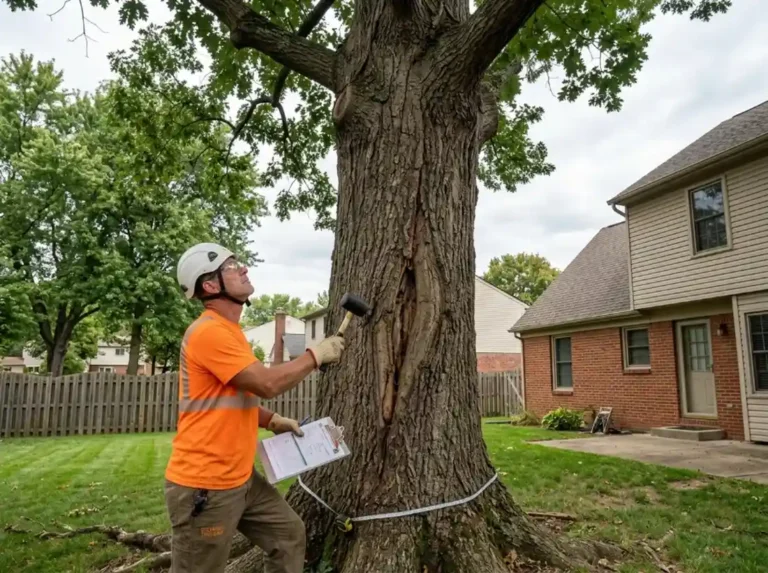
Where a tree has two competing stems or a partial split, cabling and bracing can hold it together rather than taking it out. And where the lean and the root damage have already gone too far, a risk assessment tells you that before the next storm does. If it is beyond saving, removal on a planned day costs a fraction of removal from a roof.
After a storm
If a tree is already down, or a limb is hanging, do not work under it and do not go near anything touching a power line. AEP Ohio handles trees on its distribution lines; the service drop from the pole to your house is largely your responsibility, and debris cleanup is the property owner’s expense at both levels. Call us on (614) 259-1714 for emergency response and storm damage cleanup.
Ready to Get Rid of That Stump?
BuckeyeTree Pro — 4466 Morse Rd, Columbus, OH 43230
📞 Call (614) 259-1714 Now