Land Clearing in Columbus: The Six-Month Window Nobody Mentions
There is no such thing as a land clearing permit in Columbus. You will not find one on the city’s permit list, because it does not exist. That fact misleads a lot of people into thinking clearing a lot is unregulated.
It is not. Almost every constraint on clearing land here is triggered by something other than clearing: a stormwater permit triggered by acreage, a federal wildlife law triggered by what lives in the trees, a burning rule triggered by geography, and a dig-notification law triggered by excavation. Miss one and the cost is not a fine on the clearing — it is a stopped job.
Here is what actually applies, with the numbers and the dates.
The six-month window most people have never heard of
The whole state of Ohio sits inside the range of the federally endangered Indiana bat and the northern long-eared bat. Both roost under loose bark and in cavities of ordinary trees — not caves, in summer. That produces a seasonal clearing window.
The clearest local statement of it we could find is not a guideline at all. It is a condition on a real US Army Corps of Engineers permit for a project here in Franklin County:
“Suitable habitat for the Indiana and northern long-eared bats exists within the project areas. You shall preserve trees and associated habitats wherever possible. If suitable habitat cannot be saved during construction activities, the trees should not be cut from April 1 through September 30.”
USACE Huntington District, permit file LRH-2018-01012-SCR, Franklin County
April through September prohibited is the exact mirror of the window that joint USFWS and ODNR guidance recommends: 1 October to 31 March. Clear in that half of the year and the bat question largely goes away.
Which trees count: three inches, not six
You will see both three inches and five inches quoted. Both are right — they are different species. From the USFWS range-wide survey guidelines, potential roost habitat is:
- Indiana bat — “live trees and/or snags ≥ 5 inches dbh that have exfoliating bark, cracks, crevices, and/or hollows”
- Northern long-eared bat — “live trees and/or snags ≥ 3 inches dbh that have exfoliating bark, cracks, crevices, and/or cavities”
Three inches is the lower of the two and the northern long-eared bat occurs statewide, so three inches is the operative number here. That is a sapling. On a wooded lot it means effectively everything with bark.
Why this got stricter in 2023
The northern long-eared bat was reclassified from threatened to endangered, effective 31 March 2023. That change did something specific that older articles miss. In the Service’s own words:
“Since the ESA does not allow application of 4(d) rules for species listed as endangered, once the endangered reclassification is finalized, the 4(d) rule will be nullified.”
US Fish and Wildlife Service, NLEB final rule FAQs
The 4(d) rule was the flexibility. It is gone. Any guidance you read that describes the northern long-eared bat as “threatened” predates March 2023 and should not be relied on.
Does this bind a homeowner? The honest answer
Most articles get this wrong in one of two directions — either “it’s the law, you can’t cut in summer,” or “it only applies to federal projects.” Neither is accurate. It splits into two questions.
The seasonal window as an enforced condition arrives through federal permitting. The Franklin County example above got its date restriction because the applicant needed a Corps permit. No federal permit, no federal funding — nobody hands you that condition.
The take prohibition under Section 9 applies to everyone, including private landowners on their own land. The final rule is explicit that “non-Federal projects may also be delayed as entities determine whether or not they need take coverage for their activities under section 10(a)(1)(B) of the Act,” and that for non-federal landowners, take “can be authorized through development of a habitat conservation plan and issuance of an incidental take permit.”
So the accurate framing is this: the calendar is a recommendation for a private owner, but felling an occupied roost tree in July is potential unlawful take whether or not any federal agency is involved. Clearing between October and March is simply how you avoid the question without paying for bat surveys.
Ohio state law is narrower and worth knowing for what it does not do. All four of these bats are Ohio endangered species, and it is unlawful to “take” one without a permit — but Ohio Revised Code 1531.01(G) defines take as “pursuing, shooting, hunting, killing, trapping, angling… and any lesser act, such as wounding.” That covers direct killing, not habitat removal. The federal exposure is the one that matters when you are cutting trees.
Two things we could not resolve, and are not going to paper over. First, the May 2026 ODNR and USFWS guidance attaches the October–March window to “capture record buffers” rather than stating it as a blanket statewide rule, which is narrower than the trade press usually implies. Second, an earlier 2021 version of the same guidance used a completely different window — “refrain from clearing trees from March 15 – November 15.” Two official documents, two date ranges. The newer one should control, but we found no statement formally superseding the older, and we would rather tell you that than pick one silently. Third, the tricolored bat was proposed as endangered in September 2022; we could not confirm whether a final listing has since issued. If it has, the picture tightens further.
The USFWS Ohio Ecological Services Field Office is at 4625 Morse Road in Columbus — (614) 416-8993. On a wooded lot of any size, that call before October is cheaper than a survey in June.
One acre changes everything
Ohio EPA’s construction stormwater general permit is OHC000006, effective 23 April 2023 and running to 22 April 2028. Read the first word of what it covers:

“Construction activities include any clearing, grading, excavating, grubbing and/or filling activities that disturb one or more acres.”
Ohio EPA NPDES Construction Storm Water General Permit OHC000006
Clearing is not a preliminary step outside the permit. It is the regulated activity. And the acre is not just your acre — the permit also captures sites that “disturb less than one acre of land but are part of a larger common plan of development or sale that will ultimately disturb one or more acres.” Three half-acre lots in the same subdivision phase are one permitted site.
21 days — or 45, in two Franklin County watersheds
The Notice of Intent must be in “at least 21 days (or 45 days in the Big Darby Creek watershed and portions of the Olentangy watershed) prior to the commencement of construction activity.”
Both of those watersheds are here. Big Darby Creek runs through western Franklin County — Prairie, Brown and Pleasant Townships and the Big Darby Accord area. The Olentangy runs through the north of the county and through Columbus itself. In those areas you need not only 45 days but the completed stormwater pollution prevention plan filed with the application, not afterwards. We could not extract the exact parcel boundaries from the permit’s appendices, so if your site is west or north, confirm which clock you are on before you book equipment.
The fee is modest — “$200 plus $20 per whole disturbed acre… above 5 whole acres,” capped so that a site of twenty or more disturbed acres pays “the maximum fee of $500.” The cost of getting this wrong is not the fee. It is six weeks of standing still.
One vocabulary note that marks out people who work here: Ohio calls it an SWP3, not a SWPPP. Ohio EPA’s Central District Office, which covers Franklin County, is on (614) 728-3778.
Under an acre in Columbus? Very little applies — for now
Columbus’s own stormwater obligations come from its MS4 permit, which requires the city to review and inspect “a land disturbance of greater than or equal to one acre.” Same trigger. Under an acre and outside a larger common plan, there is no city plan review either.
And on the trees themselves, the city has been unusually candid about the gap. From research the Recreation and Parks Department itself commissioned, published March 2025:
“Columbus’s current zoning code offers minimal protection for trees on private property.”
Columbus Private Tree Code Research Report, 7 March 2025
The same report says the city “lags behind its peers in implementing ordinances that protect trees on private property during development.” The exceptions are narrow — the University District Overlay restricts private tree removal, and a zoning section states that specimen trees and significant tree stands “are retained” while, as the report notes, falling “short by not mandating their retention.”
The draft numbers are already public
A private tree code is under development, and the proposed thresholds are in that report: protection starting at 6 inches DSH, with tiered replacement — 1:1 for 6 to 12 inches, 2:1 for 12 to 18, 3:1 for 18 to 24, 4:1 for 24 to 30, and 5:1 above 30 inches.
Nothing on that list is law today, and we could not confirm whether anything has been adopted since the working groups convened in 2025. But if you are holding a wooded parcel in Columbus and weighing when to develop it, those are the numbers that would apply if the draft were enacted as written. That is worth knowing before, not after.
A correction worth making: the $260 per inch is not yours
People read about Columbus charging $260 per removed trunk inch and assume it hits their lot. It does not. The Tree Technical Manual defines its scope precisely — a “Public Tree” is “any tree growing on land owned by the City including lands defined as ‘public place’, ‘public street’, or ‘park’,” and the manual “does not apply to City-owned utility easements on Private Property.”
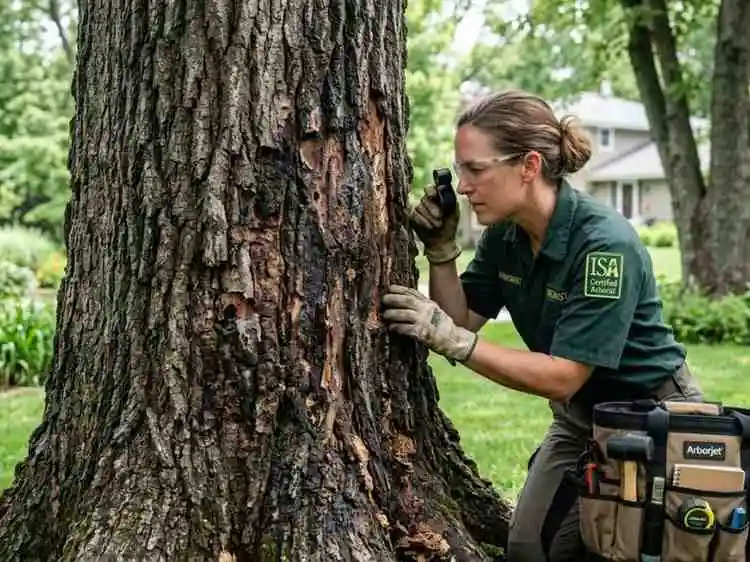
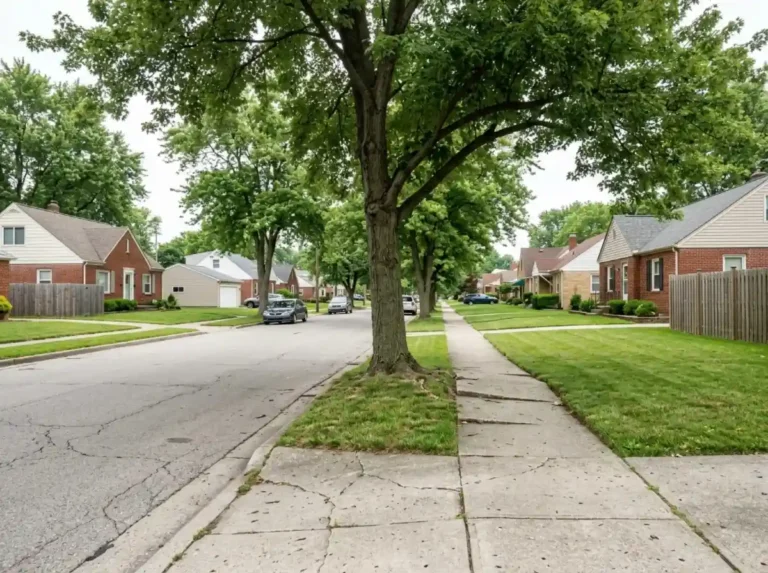
The inch-for-inch mitigation and the $260 fee attach to public trees under Chapter 912. Where they bite on a clearing job is at the edges — the street trees along your frontage, which are the city’s, and which need a free Forestry permit and a certified arborist to file it before anyone touches them. Columbus Forestry is on 614-645-6640.
You almost certainly cannot burn it
This is where clearing budgets break, because burning is what people assume they will do with the brush pile.
Ohio’s open burning rules divide the state into restricted and unrestricted areas by population, not by county. A restricted area includes any municipality plus “a zone extending one mile beyond any such municipal corporation having a population of ten thousand persons or more.”
Columbus qualifies many times over. So do Dublin, Westerville, Hilliard, Grove City, Gahanna, Reynoldsburg, Worthington, Upper Arlington, Whitehall, Bexley, New Albany and Canal Winchester — each carrying its own one-mile buffer. Overlay those buffers on a map of Franklin County and very little developed land falls outside. That is our reading of the rule rather than a quoted finding, but it is not a close call.
Inside a restricted area, “no person or property owner shall cause or allow open burning” except for a short list of exceptions — occupational heating, small bonfires, agricultural and forestry waste with prior notification. Land clearing waste is not on that list. The rule even defines it by name: “plant waste material which is removed from land… for the purpose of rendering the land useful for residential, commercial, or industrial development.”
Outside a restricted area it is still not simple. Burning land clearing waste needs written Ohio EPA permission plus an air curtain destructor, and the fire must be “located at a point on the premises no less than one thousand feet from any inhabited building.” Ohio EPA’s own guidance notes that written permission “may take two weeks.” Few Franklin County parcels can offer a thousand feet of clearance in every direction.
Plan on hauling and grinding. Columbus Division of Fire’s Fire Prevention Bureau is 614-645-7641 if you want it confirmed for your address.
Call before you dig — and the exemption that does not work
Stump grinding and grubbing are excavation. Ohio Revised Code 3781.28 requires notice “at least two working days, not including the day of the notification, but not more than sixteen calendar days before commencing excavation.” Note the ceiling — a ticket pulled too far ahead expires. Dial 811.
Now the provision that catches people. The statute does contain a homeowner exemption:
“If the owner of the property is the excavator, this section does not apply unless the excavation is planned for an area where a utility easement is located, a public right-of-way, or where utility facilities are known to serve the property.”
Ohio Revised Code 3781.28(F)(2)(a)
Read the exception. Essentially every occupied lot in Franklin County has utility facilities serving it. The exemption is real on paper and almost never available in practice.
And the next subsection removes the argument entirely for anyone hiring help: “if the owner of the property employs an excavator, the excavator shall comply.” No exemption at all. If we are on your site, we call — that is not us being cautious, it is the statute.
One caution we will flag rather than assert: we could not verify from an Ohio source how 811 treats privately owned lines — the buried run to a barn or garage, invisible fence, irrigation, a private LP line. Nationally those are generally not located by the 811 members. Assume yours will not be marked and tell whoever is clearing where they are.
Where the wood goes — and one change from last year
Here is the counterintuitive one, and it is genuinely useful. Ohio EPA guidance, citing ORC 3714.01(F):

“Construction debris and trees and brush removed in clearing a construction site can be used as fill material on the site where the materials are generated, without being regulated as a C&DD disposal facility.”
Ohio EPA guidance document GD-549
On site, from that site, is allowed. The same guidance is equally clear that the exclusion “does not cover the burying of construction materials which were not generated on the site,” and advises checking with the local board of health or zoning office first. On a large rural parcel that can remove a substantial haulage line from a quote.
Do not confuse this with “clean hard fill,” which people often stretch to cover stumps. The rule lists clean hard fill as “reinforced or nonreinforced concrete, asphalt concrete, brick, block, tile, or stone.” No vegetation. Two different provisions.
The change that matters if you are getting quotes: the city’s Com-Til compost facility posted that “as of August 8th, 2025, the Compost Facility is no longer accepting yard waste from commercial companies/vehicles.” Residential drop-off is still free. And Com-Til has never accepted stumps at all — its list covers trees, logs of any diameter, limbs, leaves and brush, but “no stumps.”
Two consequences. Contractors in Columbus no longer have a free municipal outlet for brush, so anyone quoting you as though they do is working from old information. And stumps are a separate disposal line on any honest clearing quote, because they always have been. For reference, SWACO’s Franklin County landfill posts construction and demolition debris at $39.75 per ton in-district, $43.75 out-of-district, effective 29 September 2025.
Why you are competing for a crew
New private housing structures authorised by building permits in Franklin County, from the Census Bureau’s building permits survey:
| Year | Structures authorised |
|---|---|
| 2023 | 7,252 |
| 2024 | 8,122 |
| 2025 | 10,494 |
Up about 45% in two years. Now put that against a clearing season that federal guidance pushes into October through March, and you can see the squeeze: rising demand against a six-month preferred window. If you are planning to clear this winter, the equipment is booked in autumn, not in December.
The order we would work it
- Measure the disturbance. One acre or part of a larger plan means Ohio EPA, and 21 or 45 days of lead time.
- Check the calendar. October to March avoids the bat question. April to September means either a survey or accepting risk.
- Look at the frontage. Street trees are the city’s. Free permit, certified arborist, before anyone starts.
- Find the water. A stream or wetland on the parcel pulls in the Corps and Ohio EPA and adds months.
- Call 811. Two working days, sixteen calendar days maximum, and mark your private lines yourself.
- Decide where the wood goes before the quote, not after. On-site, ground, or hauled — it is the largest variable in the price.
If you have a parcel and you are not sure which of these apply to it, ring us on (614) 259-1714 and describe the site — acreage, what is on it, whether there is water, and when you want it done. We will tell you which clocks are running before anyone quotes a number. That is what land clearing in this county actually involves, and it is why a quote that arrives in ten minutes without any of these questions is not a quote you can rely on.
Sources
- US Fish and Wildlife Service, Range-wide Indiana Bat and Northern Long-eared Bat Survey Guidelines (March 2026); NLEB endangered listing, effective 31 March 2023; NLEB final rule FAQs
- ODNR Division of Wildlife / USFWS, State Bat Survey Guidance; USACE Huntington District permit LRH-2018-01012-SCR (Franklin County)
- Ohio EPA, NPDES Construction Storm Water General Permit OHC000006 and NOI instructions
- Columbus Recreation and Parks, Private Tree Code Research Report (7 March 2025) and Tree Technical Manual (May 2024)
- Ohio Administrative Code 3745-19-01, 3745-19-03 and 3745-19-04 (open burning); 3745-400-05 (clean hard fill)
- Ohio Revised Code 3781.28 and 3781.29 (excavation notice); 1531.01 (definition of take)
- Ohio EPA guidance GD-549, construction and demolition debris
- City of Columbus Com-Til Compost Facility; SWACO disposal rates
- US Census Bureau building permits survey, Franklin County (FRED series BPPRIV039049)
How this page was written: everything in quotation marks came from the document named beside it. Nothing here is legal advice, and none of it is a substitute for asking the agency that will actually decide your case. Five things we could not confirm are flagged in the text rather than filled in: the current listing status of the tricolored bat, whether the October–March window applies statewide or only within bat capture record buffers, the conflict between the 2021 and 2026 guidance date ranges, whether any private tree code has been adopted since March 2025, and how Ohio 811 treats privately owned lines. Rules change. If an official source contradicts this page, that source is right and we will correct it.
Related services in Columbus
Ready to Get Rid of That Stump?
BuckeyeTree Pro — 4466 Morse Rd, Columbus, OH 43230
📞 Call (614) 259-1714 Now